


Can Hair Generate Electricity?
Imagine running a comb through your hair on an ordinary afternoon.
Suddenly, a few strands begin to rise. Others cling to the comb. Some seem to push away from their neighbors, floating in different directions as though an invisible force has taken control.
No wires. No batteries. No electrical outlet. Just hair, a comb, and a little movement.
So what is happening? Can human hair actually generate electricity?
The answer takes us into one of the most fascinating areas of everyday physics: electrostatics, the study of electric charges and the forces they produce.
Hair does not create electric charge out of nothing. Instead, it can acquire and retain an imbalance of charge through interactions with other materials. That imbalance can produce forces strong enough to move individual strands.
Scientists have studied this phenomenon for centuries, yet some details of how different surfaces exchange charge remain active areas of research.
Let’s explore the invisible physics hiding in a single strand of hair.
Can Human Hair Become Electrically Charged?
Yes. Human hair can acquire and retain static electric charge. When hair contacts and separates from another material, such as a comb or fabric, the interaction may cause electrical charge to be transferred or redistributed. This phenomenon is commonly associated with the triboelectric effect, also known as contact electrification.
Once strands carry similar net charges, they can repel one another, producing the familiar effect of hair standing up or spreading apart. This does not mean hair creates electrical energy from nothing or behaves like a continuously operating battery.
The surprising truth: Hair can become electrically charged without being connected to an electrical power source.
Why Does Hair Sometimes Seem to Defy Gravity?
The Invisible Force
Hair normally hangs, curls, or rests according to its natural structure, weight, and surrounding forces. But when electric charge accumulates, a new force enters the picture. Electrostatic forces can act between charged objects even when those objects are not touching.
Under suitable conditions, these forces can become large enough to change the position of lightweight hair fibers. A strand may rise toward a charged comb. Several strands may separate. During an electrostatics demonstration, a person’s hair may spread dramatically outward.
Is the Hair Moving Because of Electricity?
Yes—but the word electricity covers several different phenomena. Here, the relevant effect is usually an accumulation of charge and the forces associated with it, not a continuous current passing through the hair.
Why Is Hair Such a Good Visual Example?
Individual hair fibers are lightweight and flexible. Their movement makes an otherwise invisible electrical force easy to observe. A heavy object might experience a similar force without noticeably moving; a fine strand can reveal it.
How Can Contact Between Two Materials Create Static Charge?
The triboelectric effect is a familiar example of contact electrification. When different materials touch and then separate, electrical charge may become redistributed between their surfaces. After separation, one may carry a net positive charge and the other a net negative charge.
The total electric charge remains conserved. It is transferred or separated, not created from nothing.

Does Friction Create the Electricity?
Rubbing often makes triboelectric charging more noticeable because it repeatedly brings surfaces into contact and separates them across microscopic regions. But friction is not always necessary: contact and separation alone can produce electrification under suitable conditions.
Are Electrons Always Responsible?
Not necessarily. Introductory explanations often focus on electrons moving between materials. Depending on the surfaces and conditions, scientists also investigate ion transfer, material transfer, and surface chemistry. The dominant microscopic mechanism is not fully settled for every pair of insulating materials.
What Is a Triboelectric Series?
A triboelectric series arranges materials by their observed tendency to acquire positive or negative charge after contact. Hair appears in many educational series, but such rankings are not universal predictions. Humidity, contamination, surface treatment, and experimental conditions matter.
What Exactly Is Electric Charge?
Electric charge is a fundamental property of matter. Like charges repel, while opposite charges attract. A material can be electrically neutral overall even though it contains charged particles. Static electrification occurs when charge becomes unbalanced or redistributed.
What Happens to the Hair Fiber?
Hair is a keratin-based biological material. Its electrical behavior depends on composition, surface condition, surrounding environment, and contact with other materials. A strand may retain a net charge for some time and respond to the electric fields of nearby objects.
Can a Neutral Object Attract Charged Hair?
Yes. A charged object can attract a neutral but polarizable object by redistributing its internal charge. This helps explain why electrostatic attraction is not limited to objects with opposite net charges.
Does Hair Conduct Electricity?
Hair is not a conductor like a metal wire. Its electrical properties vary with moisture, temperature, chemistry, and measurement conditions. Moisture can influence how quickly accumulated charge dissipates. A single universal conductivity value would be misleading.
Why Do Charged Hair Strands Push Away From Each Other?
When neighboring strands acquire net charges of the same sign, they experience electrostatic repulsion. This force can make the strands separate, spread outward, or appear to rise.

What Is Coulomb’s Law?
Coulomb’s law describes the electrostatic force between idealized point charges. The magnitude of the force increases with the product of the charge magnitudes and decreases with the square of their separation.
Here, F is force magnitude, q₁ and q₂ are charges, r is their separation, and k is Coulomb’s constant in vacuum. Actual hair fibers are extended, flexible objects with complex charge distributions, so the point-charge model is only an introduction.
Why Doesn’t Every Strand Stand Straight Up?
Electrostatic forces compete with gravity, fiber stiffness, tangles, contact with neighboring strands, and variations in charge distribution. The visible arrangement reflects all these forces acting together.
Your hair is not trying to escape your head. Its charged strands are pushing away from one another.
Can Static Electricity in Hair Produce a Spark?
Static electricity can sometimes produce an electrical discharge. Under a sufficiently strong electric field, air can undergo electrical breakdown, allowing a spark to form. Ordinary hair electrification during brushing, however, does not usually produce a visible spark.
Static Electricity vs. Electric Current
| Electrical concept | Scientific meaning |
|---|---|
| Electric charge | A fundamental property of matter associated with electrical interactions |
| Static electricity | Accumulated or separated electric charge |
| Electric current | The rate at which electric charge flows |
| Electrical discharge | A transfer of charge that can occur rapidly |
| Electric field | A field that exerts forces on electric charges |
A charged hair strand does not need a continuous electric current to experience electrostatic forces. Charge movement during electrification or discharge can, however, constitute a brief current.
Can Hair Act Like a Battery?
Not in the conventional sense. A battery maintains a potential difference through electrochemical processes. A statically charged strand may temporarily store electrostatic energy, but it does not function as a conventional electrochemical power source.
Why Are Some Discharges Visible?
A visible spark requires suitable conditions, including a sufficiently strong field and a conductive discharge path. Electrostatic generators can produce dramatic sparks; ordinary combing generally produces much less spectacular effects.
Why Does Hair Stand Up Around a Van de Graaff Generator?
A Van de Graaff generator is an electrostatic device designed to accumulate electric charge on a conductive terminal. In a controlled demonstration, a person standing on an appropriate insulating platform may touch the terminal and acquire a net charge. Hair strands carrying charges of the same sign then repel one another.

Is the Generator Making the Hair Magnetic?
No. The dramatic hair-raising effect is electrostatic, not magnetic. The fibers respond to electric charges and fields.
Why Is This Experiment So Memorable?
Because it makes an invisible force visible. It connects charge transfer, repulsion, electric fields, insulation, and mechanical forces in one memorable observation.
Can This Experiment Be Recreated at Home?
High-voltage electrostatic demonstrations should not be improvised. Such equipment can produce discharges and can be unsuitable for people with certain implanted medical devices or other relevant contraindications. Demonstrations belong in appropriately supervised educational settings with suitable safety precautions.
What Does Humidity Have to Do With It?
Moisture changes the electrical properties of hair and nearby surfaces. In many everyday conditions, higher humidity promotes charge dissipation, while drier conditions allow static charge to persist. The effect is material-dependent: humidity can also influence charge generation in more complicated ways.
Five Surprising Truths About Electrically Charged Hair
| The myth | What science shows |
|---|---|
| “Hair creates electricity from nothing.” | Electric charge is transferred or redistributed; total charge is conserved. |
| “Friction is always necessary.” | Contact and separation can produce electrification without sustained rubbing. |
| “Static electricity is continuous electric current.” | Accumulated charge and continuous charge flow are different phenomena. |
| “Every material charges the same way.” | Charging depends on the materials, surfaces, and conditions. |
| “Hair standing up means it is damaged.” | Electrostatic repulsion can move otherwise undamaged fibers. |
Questions About Hair and Electricity
01. Can human hair really generate electricity?
Hair can acquire and retain static charge through interactions with other materials. It does not create electric charge from nothing or operate as a conventional electrical generator.
02. Why does hair stand up after brushing?
Contact electrification may cause strands to acquire charge. Neighboring strands with similar net charges repel one another, sometimes causing them to rise or separate.
03. Does hair always become positively charged?
No. The direction and magnitude of charging depend on the materials and conditions. Triboelectric series describe tendencies rather than universal outcomes.
04. Can hair attract objects without touching them?
Yes. Charged hair can exert forces on nearby charged objects and can attract some neutral, polarizable materials through charge redistribution.
05. Can static electricity damage hair?
Static charging alone does not establish structural damage. Mechanical friction associated with some charging situations can contribute to wear, but the phenomena should not be confused.
06. Why is static electricity more noticeable in dry environments?
In many conditions, dry surfaces dissipate accumulated charge more slowly. Humidity changes surface electrical behavior, although its effects differ among materials.
07. Is it safe to make your hair stand up using a Van de Graaff generator?
These demonstrations should be performed only in supervised educational settings with suitable equipment and safety precautions. High-voltage electrostatic equipment should not be improvised.
Scientific References
- Lacks, D. J., & Shinbrot, T. (2019). Long-standing and unresolved issues in triboelectric charging. Nature Reviews Chemistry.
- A Comprehensive Review on the Mechanism of Contact Electrification (2025). Journal of Materials Chemistry A.
- Balancing Charge Dissipation and Generation (2022). Journal of Materials Chemistry A.
- Harvard University. Hair Raising. Natural Sciences Lecture Demonstrations.
- Massachusetts Institute of Technology. Charged Person Using Van de Graaff Generator.
- National High Magnetic Field Laboratory. Van de Graaff Generator.
- University of Wisconsin–Madison. Van de Graaff Machine.
An Invisible Force Hidden in an Ordinary Strand
The next time your hair rises toward a comb or a few strands seem determined to float in different directions, remember that you are witnessing a small demonstration of fundamental physics.
Electric charge is being redistributed. Invisible fields are exerting forces. Flexible fibers are responding to interactions that also govern countless processes in nature and technology.
And behind this familiar everyday experience lies a scientific phenomenon that researchers are still working to understand in full detail.
Hair does not need a battery to become electrically charged. Sometimes, all it takes is contact, separation, and a little physics.
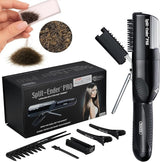
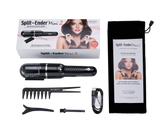
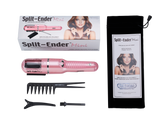
Understanding the distinction between static charge and mechanical wear also helps us make informed hair-care decisions. Gentle handling and minimizing unnecessary friction can support hair-end maintenance, while specialized trimming tools such as the Split Ender PRO2 are designed to trim protruding ends. Such tools do not neutralize electrical charge or change the physics of the fiber.
Because even the smallest strand can reveal something extraordinary about the world around us.
Less myth. More science. Better hair care.