



Can Human Hair Survive for Thousands of Years?
Imagine an archaeologist carefully opening a burial chamber that has remained undisturbed for thousands of years.
Inside are fragments of ancient textiles, traces of ceremonial objects, and the remains of a person who lived in a world almost impossible for us to imagine.
Then comes an extraordinary discovery.
Human hair.
Not a modern imitation. Not a reconstructed wig. But actual biological fibers that once grew from the scalp of someone who lived thousands of years ago.
How is that possible?
Hair is an organic material. Like other biological tissues, it can deteriorate, break down, and eventually disappear.
Yet under exceptional circumstances, its structure can survive long after the person who produced it has died.
Even more remarkably, ancient hair may preserve chemical information about diet, environmental exposure, and aspects of daily life.
Human hair can sometimes survive for thousands of years—not because it is indestructible, but because its structural chemistry and surrounding environment can slow the processes of decomposition.
The story begins with one of the most remarkable biological materials produced by the human body: keratin.
The Hair That Outlived History
How Can Hair Remain After Thousands of Years?
Human hair is a specialized biological fiber formed within a hair follicle. Once the shaft emerges from the scalp, its visible length consists primarily of nonliving, keratinized cells. Unlike living tissues, the exposed shaft does not depend on ongoing cellular metabolism to maintain its basic physical form. This helps explain why hair can remain recognizable after death. However, the absence of living cells does not make it immune to decomposition. Chemical reactions, microorganisms, moisture, and physical forces can progressively damage the fiber.
What Have Archaeologists Actually Found?
Scientific studies have examined hair recovered from Egyptian mummies, prehistoric human remains, and archaeological burial environments. One investigation published in 1999 analyzed ancient human hair samples, including material approximately 5,200 years old. Researchers found that aspects of the amino acid composition remained sufficiently preserved to support scientific analysis. This demonstrated that ancient hair could retain meaningful chemical information across extraordinary periods of time.
Does Ancient Hair Look Exactly as It Did in Life?
Not necessarily. Color, texture, surface structure, and chemical composition may change during burial or preservation. A recognizable strand may have experienced oxidation, pigment alteration, contamination, or other forms of degradation. Scientists therefore distinguish between the survival of a hair fiber and the complete preservation of its original biological condition.
The Durability Of Keratin
What Makes Human Hair So Resistant?
The primary structural framework of human hair consists of keratin proteins. These proteins are organized into a complex architecture that provides mechanical strength and flexibility. Within the hair cortex, keratin intermediate filaments and associated proteins form structural assemblies. Chemical interactions, including disulfide bonds between certain amino acid residues, contribute to the stability of this material. Together, these features make hair relatively resistant to some forms of environmental deterioration.
Can Keratin Survive for Thousands of Years?
Under favorable conditions, portions of its structure can. In a 2003 study, researchers examined hair recovered from ancient Egyptian mummies using synchrotron-based imaging techniques. They reported remarkable preservation of keratin organization in the samples examined, despite their considerable age. The findings demonstrated that certain molecular structural features can persist over archaeological timescales. However, such results should not be interpreted as evidence that all ancient hair remains perfectly intact.
Is Hair Stronger Than Every Other Biological Tissue?
No. Different biological materials have different properties, and their preservation depends on the environment. Bone, teeth, collagen-containing tissues, and keratinized fibers can all survive under particular conditions. The relative durability of hair does not establish a universal ranking of biological materials.
Does Strong Keratin Mean Hair Cannot Be Damaged?
Absolutely not. A fiber may be chemically durable under some conditions yet vulnerable to repeated mechanical stress. Combing, friction, heat, weathering, and other exposures can influence the condition of the hair shaft. The fact that ancient hair can survive for centuries does not mean that modern hair is immune to split ends or surface wear.

Nature’S Preservation Chambers
Why Do Some Environments Preserve Hair Better Than Others?
When human remains are exposed to ordinary environmental conditions, biological decomposition can progressively alter their tissues. Microorganisms, moisture, oxygen availability, temperature, and surrounding chemistry all influence this process. Under certain conditions, decomposition may slow dramatically.
How Does Dryness Help?
Many microorganisms require available moisture to remain active. Dry environments can reduce microbial activity and slow some chemical processes involved in decomposition. This helps explain why naturally desiccated remains and certain mummified bodies may retain hair. However, dryness alone does not guarantee preservation.
Can Freezing Preserve Hair?
Low temperatures can slow biological and chemical processes. Hair recovered from frozen or permafrost environments has provided valuable material for archaeological investigation. Researchers studying prehistoric hair from western Alaska have used its preserved chemical composition to investigate dietary patterns.
What About Burial Chemistry?
The surrounding soil and burial materials may strongly influence preservation. Minerals, metals, acidity, alkalinity, and other environmental characteristics can alter the stability of organic fibers. In some archaeological contexts, particular chemical conditions have contributed to exceptional preservation. Other environments accelerate deterioration.
Did Ancient Egyptians Use Hair Products?
A study published in 2011 examined hair associated with ancient Egyptian mummies and identified fatty substances consistent with ancient hair-styling preparations. The findings suggested that some hairstyles had been maintained using products applied to the hair. This provides evidence that hair styling was important long before modern cosmetics existed. But the preservation of a hairstyle should not be confused with the preservation of the entire fiber. The surrounding burial environment and mummification practices also played important roles.

What Ancient Hair Can Reveal
Can Hair Preserve Information About a Person’s Life?
Yes. One of the most extraordinary applications of archaeological hair analysis involves stable isotopes. As hair forms, its chemical composition reflects elements obtained through biological processes, including nutrition. Researchers can measure stable isotope ratios in ancient hair to investigate aspects of historical diets.
What Are Stable Isotopes?
Isotopes are forms of the same chemical element that differ in neutron number. Stable isotopes do not undergo radioactive decay in the way unstable isotopes do. In archaeological research, the relative abundance of certain stable isotopes can provide clues about dietary sources and environmental conditions. Carbon and nitrogen isotope ratios are especially useful in many dietary investigations.
Can Scientists Discover What Someone Ate Thousands of Years Ago?
They can sometimes reconstruct broad dietary patterns. For example, isotope analysis may help distinguish certain marine and terrestrial food contributions. However, results require careful interpretation. Scientists cannot simply examine a strand and identify every meal an ancient person consumed. The chemical signatures reflect complex biological and environmental processes.
Can Different Hair Segments Reveal Changes Over Time?
Potentially. Because hair grows progressively, different portions of a sufficiently preserved strand may correspond to different periods of growth. Researchers can analyze successive segments to investigate changes in chemical signals over time. Studies involving prehistoric hair from Alaska have demonstrated the potential of this approach for investigating dietary variation.
Can Hair Reveal Its Original Color?
Sometimes scientists can investigate pigmentation, but ancient hair color requires caution. Pigments may change during decomposition, burial, or chemical exposure. A reddish appearance in an archaeological specimen does not automatically establish that the person had naturally red hair during life.
Can Ancient Hair Reveal Everything About Its Owner?
No. Hair analysis provides specific kinds of evidence, not a complete biography. Dietary interpretations, environmental histories, and other conclusions depend on the quality of preservation, analytical methods, and archaeological context.

Why Most Hair Disappears
If Hair Is So Durable, Why Doesn’t Everyone’s Hair Survive?
Because durability is not the same as indestructibility. In ordinary environments, hair is exposed to processes that can progressively break down its structure. Microorganisms may colonize and degrade keratin-containing materials. Chemical reactions may alter proteins and pigments. Physical forces can fragment fibers. Over time, these processes can make hair unrecognizable or cause it to disappear.
Can Microorganisms Digest Keratin?
Some microorganisms possess biological mechanisms capable of degrading keratin-rich materials. Certain fungi and bacteria can produce enzymes that help break down structural proteins. Studies of archaeological and forensic hair have documented microbial damage and changes in fiber structure.
Does Water Destroy Hair?
Water alone does not instantly destroy keratin. However, prolonged moisture exposure can influence fiber properties and create conditions that support biological degradation. The outcome depends on temperature, microbial activity, chemistry, and other environmental factors.
Can Sunlight Damage Hair Over Time?
Yes. Light exposure can contribute to chemical changes in hair, including alterations to pigments and structural components. But archaeological preservation involves much longer timescales and a wider range of environmental influences than ordinary sunlight exposure.
Does Ancient Hair Eventually Turn Into Dust?
It may fragment and deteriorate, but there is no universal sequence in which all hair becomes dust. Different environments produce different degradation patterns. Some fibers remain recognizable. Others become severely altered or disappear.
A Strand Across Millennia
What Does It Really Mean for Hair to Survive Thousands of Years?
When scientists describe ancient hair as preserved, they may be referring to several different levels of survival. A fiber might remain visually recognizable. Its cuticle or cortex may retain identifiable structures. Certain proteins or chemical signatures may persist. Some information may be preserved even when other components have changed significantly. Therefore, preservation is not an all-or-nothing condition.
Can Hair Continue Growing After Death?
No. Hair growth requires living follicular cells and ongoing biological activity. After death, those processes stop. The familiar claim that hair continues growing after death is a myth. Changes in surrounding tissues, including dehydration and skin retraction, may create the appearance of increased hair length. But the hair shaft is not actively growing.
Could Hair Survive for Even Longer Than Thousands of Years?
The survival of hair over longer periods depends on the material and preservation environment. Scientific claims about extremely ancient fibers must be supported by reliable dating, identification, and chemical analysis. A hair-like structure is not automatically confirmed human hair.
Can We Learn About Modern Hair Care From Ancient Hair?
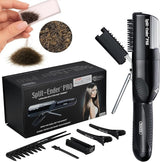
Ancient preservation studies demonstrate that hair is a sophisticated and relatively durable biological material. However, archaeological survival should not be confused with cosmetic hair health. A strand can persist under unusual burial conditions while still being vulnerable to damage during ordinary grooming. Understanding this distinction encourages a more realistic approach to hair care. Gentle handling, minimizing unnecessary friction, and maintaining the ends are practical considerations for modern hair. Specialized trimming devices such as the Split Ender PRO2 are designed to trim protruding ends. They do not preserve hair for archaeological timescales, prevent keratin decomposition, or make the fiber indestructible.
Five Surprising Truths About Ancient Hair
| The Myth | What Science Actually Shows |
|---|---|
| “Human hair is indestructible.” | Keratin is relatively durable, but hair can undergo biological, chemical, and physical degradation. |
| “Every mummy preserves its hair.” | Preservation varies according to environmental conditions and burial history. |
| “Hair continues growing after death.” | Growth stops when follicular biological activity ceases. Tissue changes can create an illusion of growth. |
| “Ancient hair always retains its original color.” | Pigments and fiber appearance may change during burial and preservation. |
| “A preserved strand is completely unchanged.” | Ancient hair can retain identifiable structures while undergoing substantial chemical alteration. |
Seven Questions About Ancient Hair
1. Can human hair really survive for thousands of years?
Yes. Scientists have recovered and analyzed human hair from archaeological remains thousands of years old. Preservation depends on environmental conditions and the stability of the surviving material.
2. Why does hair sometimes survive when other tissues disappear?
Hair contains a keratin-based structural network that can be relatively resistant to some forms of degradation. However, the survival of different tissues depends heavily on their composition and surrounding environment.
3. Can scientists determine what ancient people ate from their hair?
Sometimes. Stable isotope analysis of carbon and nitrogen can provide evidence about broad dietary patterns. The results require careful interpretation and do not identify every individual meal.
4. Did ancient Egyptians use hair-styling products?
Scientific analysis of hair from Egyptian mummies has identified fatty substances interpreted as ancient styling preparations. These findings provide evidence of historical hair-care practices.
5. Does hair keep growing after someone dies?
No. Hair growth depends on living cells in the follicle. After death, changes in the surrounding skin may create the appearance of growth, but the shaft does not continue growing.
6. Can ancient hair retain its original color?
Some pigmentation-related information may survive, but color can change during burial and decomposition. A specimen’s present appearance does not always represent its original color.
7. Does the durability of ancient hair mean modern hair cannot be damaged?
No. Long-term preservation under exceptional conditions is different from resistance to mechanical wear. Modern hair can still experience friction, weathering, breakage, and split ends.
Research Behind the Story
The following research publications provide the scientific foundation for this article.
- Documenting the Diet in Ancient Human Populations Through Stable Isotope Analysis of Hair (1999)
- Microbeam Synchrotron Imaging of Hairs From Ancient Egyptian Mummies (2003)
- Ancient Egyptian Hair Gel (2011)
- Maritime Adaptations and Dietary Variation in Prehistoric Western Alaska (2013)
- Interpreting Biological Degradative Processes Acting on Mammalian Hair (2014)
- Scientific Analysis of a Preserved Head of Hair at Romsey Abbey (2017)
- Stable Carbon and Nitrogen Isotope Analysis of Archaeological Human Hair (2022)
- The Fate of Archaeological Keratin Fibres in a Temperate Burial Context (2014)