

YOUR HAIR AGES TOO. BUT NOT EVERY STRAND AGES THE SAME WAY.
What really changes in hair over time—and why hormones, genetics, heat, color, stress and everyday wear can matter as much as the birthday on your ID.
Does Your Hair Actually Age?
Yes—but not every part of hair ages the same way. Follicles are living mini-organs, and research describes age-associated changes in pigmentation, growth patterns, diameter and density. The strand outside your scalp cannot regenerate; it accumulates weathering. So ask: is the follicle changing, or has the fiber simply been through more?
At the follicle: growth cycling, pigment, diameter and density.
On the fiber: UV, heat, chemicals, washing, brushing, friction and time.
Why does your hair have two clocks?

One head of hair can carry biological change at the follicle and years of lived experience along the fiber.
Two people are both 48. One rarely colors and uses little heat; the other has had decades of highlights, flat ironing and sun. Same chronological age, different fiber history.
What Really Changes in Your 20s, 30s, 40s, 50s… and Beyond?
Genetics, hormones, health, medications, stress and styling history all influence what a person notices and when.
Less accumulated weathering, but bleaching, heat and UV can weather hair at any age.
POSSIBLE STAGE · NOT A BIOLOGICAL DEADLINESome notice early graying or texture changes; others notice nothing.
NOT EVERY CHANGE WAS CAUSED BY TURNING 30Graying or density changes may become noticeable; perimenopause may begin for many women.
AGE CHANGES PROBABILITIES · NOT CERTAINTIESChanges may be more apparent, but two people the same age can still have very different hair.
THERE IS NO UNIVERSAL HAIR-AGING SCHEDULEWhy Can Hair Feel Finer or Less Dense With Age?
“Thinner” can mean finer strands (smaller diameter), fewer strands (changes in the number or cycling of growing hairs) or breakage through the lengths. Our guide to the four major types of hair damage explains how thermal, chemical and mechanical stress affect the fiber itself.
Why does hair turn gray?
GRAY STARTS AT THE SOURCE.
Your ends don't look at the calendar and spontaneously surrender their pigment. Hair receives pigment while the fiber is being produced within the follicle.
With graying, the follicle's pigment system changes and new fibers emerge with reduced or no visible pigment, so the important event happened before you saw the gray strand. Genetics strongly influences when it begins.
Hormones, Menopause & Hair: What Do We Actually Know?
“Menopause has nothing to do with hair” and “menopause ruins everyone's hair” are both wrong.
MENOPAUSE CAN MATTER.
MENOPAUSE IS NOT THE WHOLE STORY.
Hormones interact with follicle biology, and the menopausal transition may coincide with changes in density, diameter, shedding or texture in some women. But not every change is menopause.
Sudden or unusually heavy shedding, rapidly decreasing density, clearly defined patches of hair loss, significant scalp redness, scaling or pain, or a major unexplained change deserves appropriate medical evaluation rather than being automatically dismissed as aging.
For lifestyle factors and long-term hair care, see our guide to hair longevity, nutrition, stress, sleep and hormones.
Why Are Your Ends Basically the Veterans of Your Hair?
The farther toward the ends of long hair, the longer that fiber has faced washing, sun, blow-drying, ponytails, highlights and flat irons. The shaft cannot replace damaged cells, so weathering accumulates toward older lengths.

The farther from the root, the longer a fiber may have been collecting the physical history of everyday life.
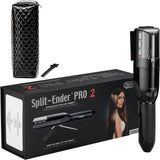
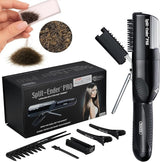
That history may show up as roughness, breakage or split ends (see the science of what happens inside a splitting hair shaft). Conditioning cannot permanently fuse a split end. For targeted trimming that helps preserve the appearance of length, explore the Split Ender PRO2. Not because it makes hair biologically younger. Because sometimes the ends simply need a trim.
Biological aging vs. accumulated damage: can you tell the difference?

A visible change is a clue—not automatically a diagnosis of “old hair.”
| WHAT YOU NOTICE | AGE / BIOLOGY MAY PLAY A ROLE | WEATHERING / DAMAGE MAY PLAY A ROLE | WHY CONTEXT MATTERS |
|---|---|---|---|
| Increasing gray hair | Yes | Not the primary mechanism | Genetics strongly influences timing. |
| Rough or less manageable lengths | Possible | Yes | Fiber history can matter greatly. |
| Split ends | Not simply an age marker | Yes | Splitting represents physical fiber damage. |
Fragile ends after years of bleaching and rapid density loss at the scalp are very different questions.
Can You Slow Hair Aging?
No product can freeze follicle biology at 25, but you can reduce some avoidable fiber wear.
🔒 NOT FULLY IN YOUR CONTROL
- Chronological age
- Genetics and inherited graying
- Some hormonal changes
✨ WITHIN YOUR INFLUENCE
- Excessive heat and UV exposure
- Aggressive chemical processing
- Mechanical handling and detangling
- Damaged-end maintenance
If heat is a regular part of your routine, our Heat Damage Hair 101 guide explains how styling habits can affect the ends over time.
What does a smart hair-longevity routine look like?
ROOTS — Watch the Biology
Rapid or unusual shedding deserves attention.
LENGTHS — Respect the History
Condition, detangle gently, limit heat and UV.
ENDS — Respect the Veterans
When splitting is present, trimming has a different job.
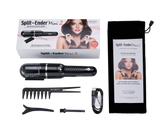
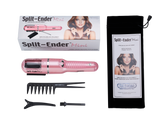
For at-home maintenance of split and damaged ends, the rechargeable Split Ender Mini 2 offers another targeted trimming option. For a broader foundation, our Complete Guide to Healthy Hair covers scalp, strands and ends.
Protect what you can. Trim what's already split.
Conditioning can improve slip, softness, manageability and surface feel. When split and damaged ends are already present, targeted trimming has a separate role in maintaining the appearance of the lengths.
EXPLORE SPLIT ENDER PRO2 →Your Hair Doesn't Need to Be 20 Forever
Ask “What has changed—and what does my hair need now?”
Questions About How Hair Changes With Age
Does hair really age?
Yes, but the follicle and visible hair fiber have different aging stories. Living follicle biology can change over time, while the keratinized hair shaft accumulates physical and chemical weathering after it emerges from the scalp.
At what age does women's hair start thinning?
There is no universal age. Hair diameter, density and growth patterns vary among individuals, while genetics, hormonal changes, inherited hair-loss patterns, health and other factors can influence when noticeable changes occur.
Why can hair become finer with age?
Age-related changes in follicle biology can affect the diameter of newly produced fibers in some people. However, finer individual strands, reduced hair density and breakage are different phenomena and should not automatically be treated as the same thing.
Does menopause change your hair?
It can be associated with hair changes in some women because the hormonal environment changes during the menopausal transition. However, menopause does not affect every woman's hair identically, and not every midlife hair change is caused by menopause.
Can you prevent hair from aging?
You cannot stop chronological aging, genetics or every hormone-related change. You can, however, reduce some avoidable fiber weathering by managing excessive heat, UV exposure, aggressive chemical processing and mechanical stress while using appropriate conditioning and end-maintenance practices.
Science Notes & Sources
This article distinguishes biological changes occurring in the living follicle from weathering of the already-formed hair shaft. Hair aging, graying and menopause-related changes are complex and vary among individuals.
Further reading: Hair Aging in Different Races and Ethnicities · Hair Graying · Menopause and the Skin