


THE HAIR SCIENCE LAB · 2026
HAIR DAMAGE
UNDER THE MICROSCOPE
What Really Happens Inside Your Hair?
CUTICLE • CORTEX • POROSITY • SPLIT ENDS
Your hair can look perfectly normal while microscopic changes are already happening along its surface.
Brushing, blow-drying, coloring, sunlight, friction against clothing, and everyday styling all influence the condition of the hair fiber. Some effects are temporary. Others involve physical changes that cannot simply be washed away.
THE SHORT ANSWER
Hair damage is structural—not just cosmetic.
Hair damage can affect the protective cuticle, the internal cortex, and the fiber's mechanical properties. Depending on the cause and severity, strands may become rougher, more prone to tangling, less resistant to breakage, or visibly split at the ends.
Important: Cuticle damage, moisture changes, cortex damage, and splitting are related phenomena, but they are not four mandatory steps that every hair fiber experiences in order.
01 / HAIR ANATOMY
What Is a Hair Fiber Actually Made Of?

Educational 3D reconstruction; internal features are illustrative rather than exact microscopic measurements.
The visible hair shaft is made primarily of keratin proteins and associated structural components.
The cuticle consists of overlapping flattened cells that form the outer surface. These layers help protect the internal fiber and influence how the hair feels, reflects light, and interacts with friction.
The cortex makes up most of the mass of many human hair fibers. Its organized keratin structures contribute substantially to strength, flexibility, and mechanical behavior, and its pigment granules contribute to natural hair color.
The medulla is a central core present in some fibers and absent or discontinuous in others. It is not the main focus in most everyday cosmetic hair damage.
02 / CUTICLE DAMAGE
Healthy vs. Damaged Cuticle: The Surface Tells a Story

A relatively intact cuticle has overlapping cells that form a smoother outer surface. With repeated weathering, cuticle edges may become chipped, lifted, worn, or partially lost. A roughened surface can increase friction between strands, so hair begins to catch on itself, becomes harder to detangle, and feels less smooth.
Does a raised cuticle always mean permanent damage? Not necessarily. Moisture and chemical conditions can temporarily change how the fiber behaves. Permanent erosion or loss of cuticle material is different from temporary swelling, which matters when evaluating claims that a product can instantly rebuild a damaged cuticle.
Porosity, Water, and the Truth About "Dry" Hair
In haircare discussions, porosity often describes how readily hair takes up and releases water. Cuticle weathering and chemical processing can change this: some damaged fibers absorb water differently, dry unevenly, or tangle more. But a rough texture does not prove a specific porosity level, and a simple floating-hair test is not a reliable laboratory measurement.
03 / CORTEX DAMAGE
What Happens When Damage Goes Deeper?

The cortex is responsible for much of the fiber's mechanical strength. Chemical processing, severe heat exposure, and accumulated physical stress can alter this internal structure, affecting tensile strength, extensibility, and the likelihood of fracture. A strand that stretches unusually, snaps easily, or feels significantly different after chemical processing may have experienced changes beyond ordinary surface roughness.
Heat, Bleach, and Mechanical Stress
Heat styling: High temperatures can alter hair's water content and physical properties. Repeated exposure may contribute to surface damage, brittleness, and breakage, particularly in chemically processed hair.
Bleaching: Oxidative chemistry lightens pigment but can also affect proteins and lipids. Repeated or poorly controlled processing increases the potential for cumulative damage, and protein loss can occur, although not every dry-feeling strand has measurable protein loss.
Mechanical stress: Forceful brushing, tight hairstyles, aggressive towel drying, and repeated friction can contribute to surface wear and breakage, even without heat or chemicals.
DAMAGE IS OFTEN CUMULATIVE
One event may cause little visible change, while repeated exposure over months can gradually reduce the fiber's resistance to future stress. Previous damage changes how hair responds to the next treatment.
04 / SPLIT ENDS
How Does a Hair Fiber Actually Split?

Split ends, also called trichoptilosis, occur when the end of a hair fiber separates into two or more sections. The ends are especially vulnerable because they are the oldest portion of longer hair and have experienced the greatest cumulative exposure to brushing, styling, friction, and environmental conditions. Some form a familiar Y shape; others show multiple branches, localized fraying, or longitudinal splitting.
Can a Split Travel Upward?
A damaged fiber may continue to fracture or split under additional stress. That does not mean every split end will inevitably travel the full length of the strand, but leaving damaged ends exposed to repeated friction can contribute to further breakage.
THE MICROSCOPIC REALITY
A split end is a physical separation of the hair fiber. Cosmetic products can temporarily smooth its appearance, but they cannot permanently rejoin the original structure of a severed strand.
05 / HAIR REPAIR CLAIMS
Can Damaged Hair Really Be Repaired?
It depends on what we mean by "repair." Conditioners, silicones, film-forming polymers, and some specialized treatments can improve manageability, reduce friction, and temporarily improve certain physical properties. But improvement in appearance or performance is not equivalent to recreating an undamaged hair fiber.
| HAIRCARE APPROACH | WHAT IT CAN DO | WHAT IT CANNOT PROMISE |
|---|---|---|
| Conditioner | Improve slip and manageability | Permanently restore lost cuticle cells |
| Hair mask | Temporarily improve softness and feel | Reverse every form of internal damage |
| Heat protectant | Reduce certain heat-related effects when used correctly | Make hair completely heat-proof |
| Trimming | Physically remove damaged ends | Repair damage remaining higher on the shaft |
How to Reduce Future Damage
Because the visible hair shaft cannot biologically regenerate the way living skin does, prevention is especially valuable. Detangle gently, choose the lowest effective styling temperature with appropriate heat protection, avoid overlapping strong chemical treatments on compromised hair, condition consistently, blot wet hair instead of rubbing it, and inspect your ends periodically, trimming as needed.
Where Does the Original Split Ender PRO Fit?
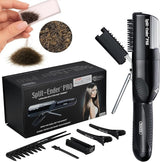
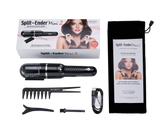
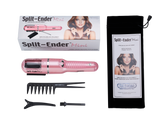
Once a strand has developed a true split end, conditioning alone cannot permanently fuse the separated fibers together; removing the damaged portion requires cutting. The original Split Ender PRO by Talavera Hair Products is designed for trimming hair ends as part of a periodic maintenance routine. It does not restore missing cuticle cells, reverse cortex damage, or change the biological structure of hair.
HAIR SCIENCE MEETS SMART MAINTENANCE
The Original Split Ender PRO
Support your haircare routine with thoughtful daily protection and periodic end maintenance.
Use the device only as directed by the manufacturer. It is not intended to be used every day, and it does not replace professional assessment when hair is severely damaged.
EXPLORE THE ORIGINAL SPLIT ENDER PRO →The key distinction: Prevention helps reduce new damage. Conditioning improves how hair feels and behaves. Trimming removes damaged portions of the fiber. These approaches complement one another but are not interchangeable.
THE RESEARCH
The Science Behind the Story
For readers interested in exploring the science of hair structure, weathering, and cosmetic treatments, these established references provide useful starting points:
Robbins, C. R.
Chemical and Physical Behavior of Human Hair. Springer. A foundational reference on the chemistry, structure, and physical properties of hair.
Dias, M. F. R. G. (2015).
Hair Cosmetics: An Overview. International Journal of Trichology, 7(1), 2–15.
Read the review →
Gavazzoni Dias, M. F. R., et al. (2014).
The Shampoo pH Can Affect the Hair: Myth or Reality? International Journal of Trichology, 6(3), 95–99.
Read the article →
Editorial note: Scientific illustrations in this article are conceptual visualizations, not actual electron microscope images. They should not be used to diagnose the condition of an individual strand.
YOUR QUESTIONS, ANSWERED
Hair Damage FAQ
Can you see hair damage without a microscope?
Yes. Visible split ends, breakage, roughness, and excessive tangling can be signs of damage. Microscopy provides more detailed information about surface structure.
Does dry hair always mean damaged hair?
No. Hair texture, environmental humidity, conditioning, and other factors influence how dry hair feels. Dryness alone does not establish the extent of structural damage.
Can a damaged cuticle grow back?
The visible hair shaft is not living tissue and does not regenerate lost cuticle cells. New hair grows from the follicle, while cosmetic treatments can improve the condition and appearance of existing lengths.
Can split ends be permanently sealed?
Cosmetic products may temporarily smooth or hold fibers together, but they do not permanently restore the original intact structure of a split end. Cutting removes the separated portion.
How often should I trim my ends?
There is no universal schedule. Frequency depends on hair condition, length goals, styling habits, and visible splitting. Follow the manufacturer's guidance when using a trimming device.
Hair Science Education | Split Ender PRO by Talavera Hair Products