

THE COLOR CHRONICLES · VOLUME 03
A Luxury Beauty & Hair Science Editorial
THE CHOCOLATE
GLOSS SECRET
Why Brunette Hair Shines—and How to Keep Chocolate Color Rich
From deep espresso and luminous cocoa to warm mocha and delicate caramel, discover the pigment science, optical beauty, and thoughtful care rituals behind spectacular brunette hair.
THE ART OF CHOCOLATE HAIR
Is darker hair naturally shinier? Not exactly: dark pigment does not automatically make hair physically smoother or healthier. Shine is an optical effect. A relatively smooth, aligned surface creates bright highlights, and those reflections stand out dramatically against a deep chocolate or espresso background.
Keeping chocolate color rich depends on how the hair arrived at its shade: natural pigment is produced during growth, while cosmetic brown color can change with washing, sunlight, heat, and previous processing. A routine that respects your scalp, texture, color history, and ends protects both color and gloss.
THE BRUNETTE BEAUTY BRIEF
Four Secrets Behind Chocolate Hair
Melanin composition and distribution influence the appearance of natural brunette shades.
Surface condition, fiber alignment, and lighting help determine how glossy hair appears.
Natural brunette hair and cosmetically colored chocolate hair may require different maintenance.
Straight, wavy, curly, and coily hair have individual styling and conditioning needs.
CHAPTER 01
The Chocolate Spectrum
Espresso, cocoa, mocha, and caramel are salon terms, not scientific classifications. Whether a brunette looks nearly black or warm and golden depends on natural pigmentation, cosmetic color when present, and lighting.

Cosmetically colored brunette hair may contain added dye molecules, altered natural pigments, or both, and highlights or balayage add differently processed sections. The right routine depends on how the hair arrived at its shade.
The Science of Brunette Pigment
Hair color is strongly influenced by melanin, produced in the hair follicle. Eumelanin is associated with brown-to-black pigmentation and pheomelanin with yellow-to-reddish pigmentation. Pigment granules sit mainly in the cortex, beneath the outer cuticle.

CHAPTER 02
Why Chocolate Hair Looks So Glossy
Hair shine is an optical effect influenced by surface condition, strand alignment, hair shape, cosmetic coatings, and lighting. When light strikes hair, some is reflected at the surface while some interacts with internal structures and pigments.

Surface Reflection
A smoother, more aligned surface can create concentrated highlights under suitable lighting.
Visual Contrast
Bright reflections can stand out dramatically against a deep chocolate or espresso background.
Does shiny hair mean healthy hair? Not necessarily. Hair can look glossy because of styling, lighting, or conditioning ingredients while still having underlying wear. Shine is a visual characteristic, not a diagnostic measurement of hair health.
Why Shine Looks Different on Different Textures

Straighter, aligned fibers can create broader highlights, while curly and coily hair changes direction along its length and distributes them differently. That is geometry and light, not proof that one texture is healthier than another.
“Every curl pattern has its own relationship with light.”
CHAPTER 03
When Chocolate Color Starts to Fade
After a salon visit, some color-treated brunettes later notice hair that looks warmer, duller, lighter, or less uniform. Some permanent oxidative systems alter natural pigment and develop color molecules within the fiber, while other products deposit color more directly or temporarily, so durability differs.
Cleansing
Repeated washing may contribute to the loss of some cosmetic colorants, depending on the dye system and hair condition.
Sun Exposure
Ultraviolet exposure can contribute to photochemical changes affecting hair color and fiber components.
Heat & Styling
Excessive heat may affect hair condition and, depending on the formulation, the appearance of cosmetic color.
Previous Processing
Previously lightened or chemically treated sections may retain and display cosmetic color differently.
Why Does Brown Hair Sometimes Look Reddish or Coppery?
Warm reflections may become more visible as cosmetic color changes, especially on previously lightened hair. A warm result is not automatically a problem; some brunette shades are designed with golden or caramel undertones.
Colorist's perspective: For a cooler espresso shade or to correct unwanted warmth, a professional can evaluate your starting color and recommend an appropriate toning approach; the right choice depends on the actual undertone.
CHAPTER 04
The Chocolate Gloss Ritual
Brunette beauty is not about the heaviest mask or the glossiest serum. Colored chocolate hair may need extra attention to color preservation; natural brunette hair may need little.

There is no universal washing frequency for every brunette. Hair that has never been colored does not need dye-maintenance products simply because it is brunette.
Suitable conditioners can improve lubrication, reduce friction, and make hair easier to detangle.
Some cosmetic products temporarily smooth the surface or modify its reflective appearance. They are not permanent structural repair.
Heat-protective products may help reduce certain effects, but they cannot eliminate all thermal risk.
Consider physical sun protection outdoors, and rinse after saltwater or pool chemicals.
Color-depositing products and salon gloss services may help refine certain cosmetic shades. Seek professional advice for significant color correction.
CHAPTER 05
Keep the Shine, Love the Ends
The ends are usually the oldest visible portions of the hair shaft, so after repeated brushing, washing, styling, and friction they may become rougher, more fragile, or visibly split. Hair does not biologically repair itself after emerging from the scalp, and no cosmetic product can permanently fuse a split tip back together. Trimming is the practical way to remove that section.
“Long hair is not only about growth. It is also about caring for the length you have.”
Thoughtful handling, appropriate conditioning, and trimming when needed can support the appearance of beautifully maintained ends.
THE CHOCOLATE LENGTH-MAINTENANCE EDIT
Rich Color.
Beautiful Lengths.
Thoughtfully Maintained Ends.
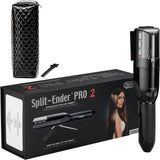
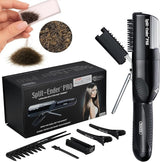
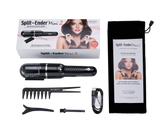
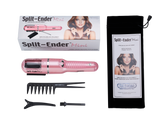
Split Ender hair-trimming tools are designed to trim hair tips, including some split or damaged ends, while aiming to preserve the appearance of overall length. They do not reverse chemical processing, rebuild damaged hair proteins, or make hair grow faster.
THE PROFESSIONAL EDIT
Split Ender PRO
Explore the professional-oriented hair-end trimming model.
DISCOVER PRO →THE PRO COLLECTION
Split Ender PRO2
Discover another option in the professional lineup.
DISCOVER PRO2 →Always review the directions and compatibility information for the specific tool, especially when working with tightly curled, fragile, or chemically processed hair.
THE BRUNETTE BEAUTY DESK
The Chocolate Beauty FAQ
Is brunette hair naturally healthier than blonde hair?
No. Natural hair color alone does not determine overall fiber condition. Chemical processing, mechanical wear, environmental exposure, and individual hair characteristics all matter.
Does chocolate-brown hair dye fade?
Cosmetic brown shades can change over time. The extent and pattern depend on the dye system, hair history, cleansing habits, environmental exposure, and maintenance.
Why does dyed brunette hair become warmer?
Changes in cosmetic color may reveal warmer-looking underlying tones, particularly on hair that was previously lightened or chemically processed.
Do hair gloss treatments permanently repair damage?
No. Cosmetic gloss products may temporarily improve color, smoothness, or reflective appearance, depending on their formulation, but they do not biologically restore a damaged hair shaft to its original condition.
BEHIND THE BEAUTY
The Science Behind This Edition
This editorial draws on established principles of human hair pigmentation, hair-fiber anatomy, optical reflection, cosmetic coloring, and hair weathering.
Further reading and research:
- MedlinePlus Genetics — Hair Color and Genetics
- PubMed — Research on Human Hair Melanin
- PubMed — Research on Hair Shine and Light Reflection
- PubMed — Research on Hair Dye and Color Fading
- PubMed — Research on Hair Cuticle Weathering
The scientific hair-fiber images in this article are conceptual educational illustrations. They are not actual microscope photographs or quantitative representations of pigment concentration, fiber damage, or optical behavior.
Editorial note: This article provides general educational information about hair science and cosmetic care. Individual results depend on hair texture, chemical history, styling habits, product formulation, and professional technique. Natural brunette color does not inherently indicate healthier or stronger hair. Cosmetic shine should not be confused with structural repair, and physically split ends cannot be biologically restored to their original intact state. Always follow product instructions and seek qualified professional guidance for chemical coloring services.