

THE HAIR SCIENCE CHRONICLES
THE BILLION-DOLLAR HAIR EDITION · VOL. 01
THE GLASS HAIR
ILLUSION
Why the World's Glossiest Hair Is Not Always Its Healthiest
THE EDITOR'S LETTER
When Hair Becomes a Mirror
Glass hair is less a single treatment than a visual ambition: sleek strands whose surface looks exceptionally uniform, with brilliant reflections running down the lengths. But a mirror-like finish tells you how light behaves on a surface, not everything about the condition of the hair underneath. It may come from excellent grooming, carefully chosen formulas, heat styling, professional lighting, or all of these together. Shine is a visual property; hair health is a much broader story.
A red-carpet finish can combine a professional blowout, a flat iron, a smoothing serum, a glossing treatment, and even added hair, all lit by directional studio lights. Those are styling choices, not proof that every strand is undamaged.
Glass hair is also often associated with straight styles, but straightness is not a biological definition of health. Curly, coily, and textured hair can be beautifully maintained without resembling a flat reflective sheet.
The most glamorous illusion in beauty may be the belief that extraordinary shine tells the entire story.
CHAPTER 01 · THE OPTICS
The Physics of Perfect Shine

When light reaches a hair fiber, some reflects from the surface while the rest interacts with internal structures.
Meet the Cuticle
The cuticle is the outermost layer of overlapping cells protecting the fiber. Friction, chemical treatments, UV exposure, and repeated heat styling can alter it over time, and a more irregular surface scatters light, reducing the continuous highlight.
Specular vs. Diffuse Reflection
Specular reflection produces a concentrated highlight, like light on a polished surface; diffuse reflection spreads light in more directions for a softer look. Glass hair relies on strands aligned in a consistent direction to form visible specular highlights. Conditioners, controlled blow-drying, and styling can temporarily improve that alignment, but a smoother appearance does not mean the internal fiber has been permanently repaired.
A mirror-like finish is an optical achievement—not a complete diagnostic test of hair health.
Scientific note: The image above is a conceptual visualization of hair surface structure and reflection, not an actual microscope photograph.
CHAPTER 02 · THE FORMULA
The Silicone Illusion
Silicones are among haircare's most misunderstood ingredients: essential for gloss to some, always to be avoided for others.
Why Cosmetic Chemists Use Silicones
Silicones such as dimethicone and amodimethicone can improve slip, reduce friction and frizz, aid combability, and create a more polished finish, depending on the specific product. Some conditioning ingredients deposit on the hair surface, changing its feel and optical properties, so weathered hair can look smoother and shinier even though its history of damage has not disappeared. Improving appearance is not the same as permanently restoring damaged structure.
Are Silicones Bad for Hair?
Not inherently. Performance varies by formulation, hair type, and cleansing routine, and some products feel too heavy for some people. Cosmetic conditioning is a legitimate benefit; the illusion begins only when a temporary finish is mistaken for structural repair.
Beautifully coated hair can look extraordinary. But appearance and structural integrity are not identical.
CHAPTER 03 · THE SALON REVOLUTION
The Gloss Treatment Revolution

Professional glossing services are often promoted to refresh tone and enhance shine, but not every product called a gloss works the same way.
Gloss vs. Glaze vs. Toner
“Gloss” may mean a temporary shine treatment, a color-depositing formula, or a demi-permanent color service; some mainly condition, others deposit pigment or involve oxidative chemistry. A glaze often describes a more temporary surface finish, and a toner generally adjusts color tones. Since terms vary by salon, ask about the chemistry, processing, and maintenance.
Can Gloss Repair Hair?
A gloss may improve softness, manageability, and shine, but no ordinary cosmetic gloss should be assumed to permanently reconnect split ends or reverse structural damage. Some color services involve chemical processing, so suitability depends on the formula and the hair's treatment history.
The finest salon result is not simply the glossiest finish. It is the finish that respects the condition of the hair.
CHAPTER 04 · THE HIDDEN COST
The Hidden Cost of Perfection
Glass hair looks effortless, but creating it repeatedly may involve frequent blow-drying, flat ironing, chemical processing, or tension from styling tools, which can add up to cumulative wear.
The Heat Paradox
Heat makes fibers look smoother and more aligned, but excessive or repeated exposure can damage the cuticle, creating the very irregularities that make shine harder to keep.
The Cumulative Damage Effect
Hair fibers do not regenerate once they leave the scalp, so the oldest portions, usually the ends, often show the most weathering. Repeated chemical processing on compromised lengths deserves particular caution.
The Difference Between Frizz and Damage
Frizz is not always damage: natural texture, humidity, and curl pattern all play a part. Conversely, a sleek finish does not guarantee that the fiber is free from breakage or chemical wear.
The goal should never be to sacrifice tomorrow's hair for tonight's reflection.
CHAPTER 05 · THE SMART ROUTINE
How to Create Glass Hair Without the Damage
No method is completely risk-free for every glass-hair style, but thoughtful choices reduce unnecessary stress.
01 — Begin With Appropriate Cleansing
Choose a shampoo suited to your scalp, hair type, and routine. Excessive washing is not required for shine.
02 — Condition the Lengths
Conditioner improves detangling, reduces friction, and makes hair feel smoother.
03 — Reduce Mechanical Stress
Detangle gently with brushes and combs that suit your texture.
04 — Style With Sensible Heat
Use the lowest effective temperature, a suitable heat protectant, and as few passes as possible. Heat protectants reduce certain risks but do not make high-temperature styling harmless.
05 — Choose Lightweight Finishing Products
A small amount of serum may improve the finish. More product does not mean more shine and can weigh some hair down.
06 — Respect Your Natural Texture
Glass-like luminosity can mean sleek straight lengths, reflective curls, defined waves, or polished natural texture.
07 — Maintain the Ends
Finishing products can temporarily improve worn ends but do not permanently rejoin split fibers. Trimming damaged tips when appropriate is one practical part of maintaining long hair.
Luxury haircare is not about using the most products. It is about choosing the right techniques and using them thoughtfully.
THE SPLIT ENDER EDIT
Beautiful Shine.
Thoughtfully Maintained Ends.
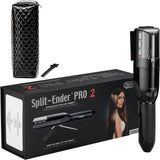
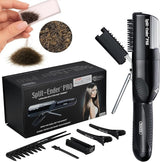
For visibly frayed or split tips, Split Ender tools offer a cosmetic trimming option intended to remove some damaged ends while helping preserve overall length. They do not stimulate growth or permanently repair a damaged hair shaft.
Split Ender PRO
Explore the salon-professional cordless split end hair trimmer.
DISCOVER SPLIT ENDER PRO →THE BEAUTY SCIENCE DESK
Frequently Asked Questions
Is glass hair a sign of healthy hair?
Not by itself. Gloss is influenced by the hair surface, products, strand alignment, pigment, and lighting. It cannot reveal every form of underlying damage. Darker hair does not always shine more either: it can produce dramatic highlight contrast in some lighting, but shine depends on multiple optical and styling factors.
Do silicones damage hair?
Silicones are a broad ingredient category. Many are used to improve slip and shine; performance depends on the formulation and how it is used. They can make weathered hair look smoother, but that is not permanent structural repair.
Can a hair gloss repair split ends?
A gloss can improve appearance and feel, but it does not permanently rejoin split fibers. How often to gloss depends on the product, its chemistry, the hair's condition, and the professional's recommendations. Split Ender devices are intended to cosmetically trim some split or damaged hair tips; they do not stimulate growth or repair follicles.
Does heat protectant prevent all damage?
No. It may reduce some forms of heat-related damage, but temperature, technique, and frequency still matter. Use the lowest effective temperature and avoid repeated passes whenever possible.
Can curly hair have a glassy shine?
Yes. Shine appears differently across textures. Straightness is not a requirement for healthy-looking, reflective hair. For some people glass-like luminosity means sleek straight lengths; for others it means reflective curls, defined waves, or polished natural texture.
RESEARCH & FURTHER READING
A Closer Look at Hair Science
Hair Cosmetics: An Overview — Scientific Review
PubMed — Hair Cuticle, Optical Properties and Shine
PubMed — Hair Fiber Heat Damage
PubMed — Silicone Conditioning and Hair Fibers
American Academy of Dermatology — Haircare Guidance
Some links are literature searches for further exploration, not individual studies proving every cosmetic claim or a specific product outcome.
Editorial disclaimer: This article provides general cosmetic education and is not medical advice. Product performance and treatment outcomes vary. Consult a qualified professional for persistent hair loss, scalp disease, or significant breakage. Split Ender tools are cosmetic hair-tip trimmers and do not medically treat hair or scalp conditions.