

THE HEAT-FREE
HAIR REVOLUTION
What Really Happens When You Stop Straightening Your Hair?
THE SCIENCE OF HEAT DAMAGE, NATURAL TEXTURE, HAIR RECOVERY & REDISCOVERING YOUR WAVES AND CURLS
What really happens when you stop straightening your hair?
You remove one repeated source of heat stress, and that is the most immediate change. Your natural wave or curl pattern may become more visible, because temporary straightening no longer masks it, and new styling habits can make hair easier to manage. What does not happen: damaged fibers do not regenerate, heat-altered lengths may not return to their old pattern, your follicles do not speed up, and split ends still need trimming. Replacing damaged lengths takes new growth and gradual trims.
THE STRAIGHTENING OBSESSION
Why We Fell in Love With Perfectly Straight Hair

There is nothing wrong with loving straight hair. The question is what happens to the fiber when high-temperature styling becomes frequent.
Temporary straightening versus chemical straightening
Hair is largely keratin protein, and its shape depends on interactions within and between those proteins. Water and heat temporarily change some of the weaker interactions, which is how a flat iron, using heat and pressure, produces a straighter arrangement without altering your genetic texture. Washing lets it return toward its usual pattern. Chemical relaxers and some smoothing systems instead alter hair structure, and those changes may persist in the treated lengths until they grow out or are cut away.
Temporarily straightening hair with heat and chemically changing the hair fiber are not interchangeable processes. The recovery and grow-out experience depends on what was done to the hair.
THE HEAT DAMAGE EFFECT
What Flat Irons Really Do to the Hair Fiber

A flat iron can create a remarkably polished surface, but a glossy finish does not mean the fiber has become stronger. The cuticle, the overlapping outer cells that protect the inner hair, can weather under repeated high heat, along with internal proteins, leaving hair rougher and more prone to tangling and breakage. Severity depends on temperature, duration, frequency, and existing damage, and bleached hair may be particularly vulnerable. A very high setting does not mean every hair type needs it, and conventional flat irons should generally be used on fully dry hair.
Experimental hair-fiber research has documented structural changes associated with heat exposure. These findings support limiting unnecessary thermal stress, but they do not mean every instance of heat styling causes the same amount of damage.
What heat damage can look like
- More tangling and increased breakage during handling.
- Split ends and weakened-looking tips.
- Reduced elasticity or an altered curl pattern in some cases.
These signs can also come from chemical processing, environmental exposure, and mechanical stress.
THE FIRST 30 DAYS WITHOUT HEAT
Why Your Natural Texture May Surprise You

One day your hair looks wonderfully soft; the next, one side forms elegant waves while the other stays determined to remain straight. Uneven patterns are common where sections had different amounts of heat or chemical processing. Some people discover strong waves, others subtle bends, and naturally straight hair generally stays straight.
A diffuser, curl cream, or leave-in conditioner can quickly reshape the finish, though too much weight can flatten fine waves. But an improved appearance after one or two washes does not prove that damaged fibers have regenerated.
Thirty days can be a useful observation period for learning new styling habits. It is not a guaranteed timeline for repairing structural heat damage.
THE TEXTURE REAWAKENING
Waves, Curls & the Hair You Forgot You Had

Hair texture is influenced by genetics, follicle characteristics, and the structure of the growing fiber. Refusing to use a flat iron does not create a wave; it lets an existing pattern show. Different areas of the scalp may also produce different patterns or densities, so the front may wave beautifully while the ends stay straighter.
When heat has altered the curl pattern
Excessive heat can sometimes cause persistent changes. If a damaged length no longer forms its previous curl, simply waiting may not restore it. New hair from the follicle may show your usual natural texture, and trimming the older lengths gradually reduces the proportion of altered hair.
THE HAIR RECOVERY TIMELINE
What Can Improve and What Cannot Be Reversed

Hair can look better, feel smoother, and become easier to manage. But existing damaged fibers do not regenerate like living tissue. Conditioners reduce friction and temporarily smooth the surface, which is useful but not regeneration. Over months, less heat and gentler handling may mean less breakage and better length retention, without the follicles producing hair any faster. Scalp hair commonly grows around one centimeter per month on average, so replacing long damaged lengths may take many months or years.
| Change | What to Expect |
|---|---|
| Less new heat exposure | Immediate reduction in that source of stress. |
| Smoother feel | Possible cosmetic improvement with conditioning. |
| More visible waves | Possible after changing styling habits; varies by texture and damage. |
| Less breakage | May develop with gentler handling and reduced damage. |
| Replacement of damaged lengths | Requires new growth and gradual trimming. |
| Permanent repair of split ends | Not achieved by stopping heat or applying conditioner. |
Where split end trimming fits
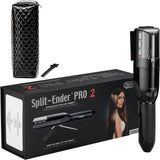
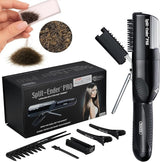
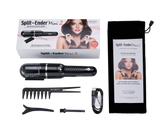
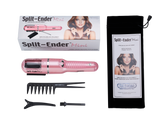
Split ends are a separation of the hair fiber. A conditioner can make them temporarily less noticeable, but it cannot fuse them back into intact hair; removing the damaged portion requires trimming. Split end trimming tools such as the Split Ender PRO and the Split Ender Mini can play that role. They are not treatments for scalp disease, hair loss, or growth rate, and they do not replace a conventional haircut when you want a new shape.
Thoughtful Split End Maintenance
Explore Split Ender PRO2, a tool designed for trimming split ends while maintaining your preferred length.
Discover Split Ender PRO2THE NO-HEAT BEAUTY ROUTINE
How to Style Your Hair Without a Flat Iron

A break from flat ironing does not mean giving up beautiful hairstyles, and it need not be all or nothing: a low-heat, carefully controlled blow-dry is not the same as repeated exposure to a very hot flat iron.
- Use a shampoo and conditioner appropriate for your scalp and hair type, focusing cleansing on the scalp.
- Remove excess water gently with a soft towel or microfiber fabric.
- Detangle with care, starting at the ends when appropriate.
- For waves, apply a suitable product to damp hair and scrunch upward; for curls and coils, section and distribute product carefully.
- Try heatless setting: satin curling ribbons, soft rollers, or loose braids, without tight tension.
- Trim damaged ends when needed.
A routine is only luxurious if it works for your life. Beautiful hair care should feel sustainable, not like an exhausting full-time job.
Frequently Asked Questions
1. What happens when you stop straightening your hair?
You reduce exposure to that source of heat. Your natural pattern may become more visible, and different styling habits may improve manageability. Previously damaged fibers do not automatically regenerate, so older lengths may still need time and trimming.
2. Will my natural curls come back if I stop using a flat iron?
If straightening was temporary, your natural pattern may become visible again after washing. Persistent structural damage may prevent some older lengths from returning fully to their previous behavior.
3. How long does it take hair to recover from heat damage?
There is no universal recovery deadline. Cosmetic appearance may improve quickly, while replacing structurally damaged lengths requires new growth and trimming over time.
4. Does stopping heat make hair grow faster?
Not necessarily. Reducing heat may decrease breakage and improve length retention, but that is different from increasing the follicle's biological growth rate. Scalp hair commonly grows around one centimeter per month on average.
5. Can split ends heal without trimming?
No. Products may temporarily smooth their appearance, but removing the split portion requires trimming. Conditioner can reduce friction and improve softness and manageability, but it does not permanently rebuild severely damaged hair structures.
Science & Further Reading
- American Academy of Dermatology. Tips for Healthy Hair. Dermatologist guidance on washing, conditioning, detangling, and limiting heat-related damage. Read the guidance .
- American Academy of Dermatology. Hair Styling Without Damage. Recommendations for reducing avoidable damage from grooming and heat styling. Read the guidance .
- Lee, Y., et al. (2011). Hair Shaft Damage from Heat and Drying Time of Hair Dryer. Annals of Dermatology, 23(4), 455–462. Experimental research examining hair damage under different drying conditions. Read the study .
- Dias, M. F. R. G. (2015). Hair Cosmetics: An Overview. International Journal of Trichology, 7(1), 2–15. Overview of hair-fiber structure, cosmetic treatments, conditioning, and hair-care products. Read the review .
- Gavazzoni Dias, M. F. R., et al. (2014). The Shampoo pH Can Affect the Hair: Myth or Reality? International Journal of Trichology, 6(3), 95–99. Discussion of hair-fiber behavior, surface interactions, and cosmetic formulation. Read the review .
Editorial disclaimer: This article provides general educational information about hair fibers, heat styling, and cosmetic hair care. Results vary by individual texture, hair history, and styling practices. It is not a medical diagnosis or a substitute for professional dermatologic advice. Split Ender products are split end trimming tools. They do not biologically repair damaged hair fibers, reverse permanent heat damage, treat scalp conditions, or accelerate hair growth.