

THE SCIENCE OF BEAUTIFUL HAIR
AN EDITORIAL INVESTIGATION
THE INVISIBLE
AGE OF HAIR
Why Your Hair Ages Differently From Roots to Ends
Every strand carries a history. Some of it is only weeks old. Some of it has survived years of brushing, sunlight, heat, and everyday life. What happens along the way?
BEAUTY SCIENCE / HAIR LONGEVITY
Your hair may look like one beautiful, continuous length. But hidden within every strand is a timeline.
The hair near your roots is relatively new. The hair at your ends may have survived years of brushing, washing, styling, sunlight, humidity, and friction. Same head. Same strand. Completely different histories.
Hair does not age biologically the way your skin does. The visible shaft is made primarily of nonliving, keratinized cells and cannot regenerate itself. Instead, it experiences weathering: gradual physical and chemical changes from environmental exposure, grooming, and cosmetic treatments. That is why ends often become rougher, more fragile, or more prone to splitting.
THE SCIENCE IN 30 SECONDS
Does older hair mean damaged hair?
Not necessarily. Older sections of hair have had more time to encounter potentially damaging exposures, but their condition depends on hair type, styling habits, chemical treatments, environment, and care. Over time, accumulated wear may affect the cuticle and underlying cortex, increasing roughness, tangling, breakage, or split ends.
CHAPTER 01
Every Strand Has a Timeline
Human scalp hair grows, on average, approximately 1 centimeter per month, although individual growth rates vary. At that rate, a section of hair 30 centimeters from the scalp may represent roughly two and a half years of growth. It is an estimate, not a biological clock, and trimming changes the age of the surviving ends.
A STRAND'S APPROXIMATE HISTORY
5 CM FROM ROOT
5
months
15 CM FROM ROOT
15
months
30 CM FROM ROOT
30
months
45 CM FROM ROOT
45
months
Illustrative estimates assuming 1 cm of growth per month, measured along a strand from the scalp. Not a diagnostic test or a prediction of damage.
Older hair is not automatically unhealthy, but older sections have accumulated a longer exposure history, like a silk blouse worn every day for three years. That is why protecting length is different from simply encouraging growth.
CHAPTER 02
The Cuticle: Your Hair's First Defense
Under magnification, a hair shaft is not a perfectly smooth cylinder. Its outer surface is covered by overlapping cuticle cells, arranged like tiny protective shingles that help protect the inner fiber and influence how hair feels, moves, and reflects light.

Repeated grooming, chemical processing, and environmental exposure may gradually alter or remove portions of the cuticle, so the hair can become harder to detangle and feel rougher.
Relatively Intact Cuticle
More continuous protective coverage, generally lower surface roughness, and more predictable movement between fibers.
Weathered Cuticle
Localized abrasion, irregular edges, or cuticle loss that may increase friction and vulnerability to further wear.
This is one reason long hair can feel silky near the roots but noticeably rougher at the ends.
What happens beneath the surface?
Beneath the cuticle lies the cortex, which makes up much of the fiber's mass. Its elongated cells and organized keratin structures contribute to the hair's strength, elasticity, and behavior under tension. A central medulla may be present, discontinuous, or absent.

Can damage reach the cortex? Yes. Chemical processing, excessive heat, and mechanical stress can affect more than the outer surface and reduce the fiber's ability to withstand tension. But not every rough strand has significant internal damage, and appearance alone cannot tell us what is happening inside.
SCIENCE NOTE: Conditioners and certain cosmetic treatments can improve lubrication, manageability, and the appearance of damaged hair. These benefits should not be confused with restoring a severely fractured hair fiber to its original biological structure.
CHAPTER 03
The Invisible Damage Timeline
Hair weathering rarely comes from one ordinary event. More often, it reflects a combination of exposures repeated over time.
☀️
Sunlight
UV exposure can contribute to changes in hair proteins, pigments, and surface properties.
♨️
Heat
Excessive thermal exposure, especially with improper technique, may alter fiber structure.
✦
Chemical Services
Bleaching, coloring, and certain reshaping treatments can affect the cuticle and cortex.
↔
Friction
Repeated brushing, rubbing, and detangling can contribute to mechanical wear.
The surprising part? Normal grooming and environmental exposure can contribute to gradual surface changes, even in untreated hair. That does not make everyday brushing harmful; it means technique matters. Gentle detangling, suitable tools, and minimizing unnecessary pulling can help reduce avoidable stress.
“The question isn't whether your hair has lived. It's how gently you've helped it live.”
CHAPTER 04
When the Oldest Hair Begins to Split
A split end occurs when the end of a hair fiber separates longitudinally into two or more sections. Cuticle loss, mechanical stress, and other forms of weathering may make the fiber more vulnerable to splitting.

Can a split end repair itself?
No. The exposed hair shaft has no living repair system capable of biologically rejoining a fractured end. Certain products can temporarily improve the appearance or feel of damaged ends by coating, conditioning, or smoothing the fibers, but that is not the same as permanently restoring a physically split strand.
THE IMPORTANT DISTINCTION
Conditioning: helps improve softness, slip, and manageability.
Protective habits: help reduce avoidable future wear.
Trimming: physically removes damaged tips, including split ends that fall within the trimmed portion.
Where Split Ender Fits Into the Story
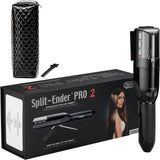
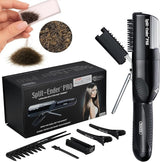
Split Ender hair-trimming tools are designed to help trim hair tips, including some split or damaged ends, while aiming to preserve the appearance of overall length. They do not repair the cortex, reverse chemical damage, or prevent all future splitting. Their role is mechanical trimming, not molecular restoration.
THE LENGTH-MAINTENANCE EDIT
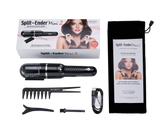
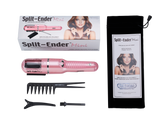
Meet the Split Ender Collection
Explore the tools designed for trimming hair ends as part of a regular maintenance routine.
CHAPTER 05
The Hair Longevity Blueprint
Hair longevity is not about making the visible hair shaft biologically younger. It is about preserving the appearance, manageability, and structural integrity of the lengths you already have.

01 / Reduce unnecessary friction
Detangle gently, work through knots without force, and use tools suited to your hair texture.
02 / Use heat thoughtfully
Avoid excessive temperatures and consider heat-protective products when appropriate.
03 / Condition according to your needs
Conditioners can improve lubrication and manageability, helping reduce friction during combing.
04 / Be strategic with chemical treatments
Avoid unnecessary overlapping processes and seek professional guidance for major color or texture changes.
05 / Pay attention to the ends
Check for visible splitting, persistent tangling, or roughness and trim damaged tips when appropriate.
CHAPTER 06
Questions Worth Asking
Does hair actually age?
Visible hair does not undergo biological aging like living skin. However, it can accumulate physical and chemical weathering as it remains exposed to grooming and the environment.
Are the ends always the oldest part?
Along an individual unbroken hair shaft, the tip generally represents the earliest-formed surviving portion. Trimming removes older portions, and hairs on the same head can be at different growth stages.
Can conditioner permanently repair split ends?
Conditioning products can improve softness, reduce friction, and temporarily improve appearance. They do not permanently rejoin a physically split hair tip.
How often should I trim my hair?
There is no universal schedule. Frequency depends on the condition of your ends, styling habits, hair goals, and how quickly visible splitting or breakage develops.
Scientific Reading & Further Exploration
Robbins, C. R. Chemical and Physical Behavior of Human Hair. Springer. A foundational reference on hair-fiber structure, physical properties, and chemical behavior.
Gavazzoni Dias, M. F. R. “Hair Cosmetics: An Overview.” International Journal of Trichology (2015). A review discussing hair-fiber structure, cosmetics, and damage-related considerations. Read the review.
Draelos, Z. D. “Hair Cosmetics.” Dermatologic Clinics (2013). Background reading on cosmetic haircare and fiber-related considerations.
Editorial note: This article provides general beauty-science education. Illustrations are conceptual scientific visualizations, not laboratory micrographs or diagnostic images. Hair growth and damage vary among individuals. Product references describe intended trimming functions and do not imply biological repair of damaged fibers.