


THE HAIR SCIENCE CHRONICLES
BLACK PEARL & SILVER MOON EDITION
THE SILVER &
SHADOW PARADOX
When Hair Loses Its Pigment, Does It Gain a New Personality?
Two colors. One fascinating biology. A little hair drama.

THE EDITOR'S LETTER
Two Queens. Two Colors. One Fascinating Hair Mystery.
Meet the Midnight Queen. Her hair is as dark as obsidian, with dramatic highlights that seem to glow against the deepest black.
Across the room stands the Silver Queen, wearing a luminous cascade of natural gray and white hair.
One claims she has the most beautiful shine. The other insists she has the most extraordinary light.
Who is right?
Science has a surprise for both.
Hair color alone does not determine the strength, condition, or beauty of the hair fiber. Pigmentation, surface reflection, texture, and cumulative damage are different parts of a much bigger story.
"Black is not automatically stronger. Silver is not automatically weaker. And shine is not a complete measure of hair health."
CHAPTER 01
The Great Pigment Disappearance
Why does naturally dark hair eventually become gray, silver, or white?
Human hair receives its natural color from melanin, a family of pigments produced by specialized cells called melanocytes during hair formation.
Two major pigment families help explain natural hair color.
Eumelanin
The pigment family strongly associated with brown and black hair coloration.
Pheomelanin
The pigment family associated with yellow-to-reddish coloration.
Natural hair color depends on the amount, characteristics, and distribution of pigments, along with the way light interacts with the fiber.
As pigment production declines, newly growing hair may emerge with reduced coloration.
Gray-looking hair often contains a mixture of pigmented and unpigmented strands, while white hair contains little or no visible pigment.

Conceptual scientific illustration. Not actual microscopy.
Why Does Hair Turn Gray?
Genetics and age-related changes in the hair follicle play important roles.
Research has also examined oxidative stress, melanocyte function, and the biological systems that maintain pigment-producing cells.
Graying is commonly a normal part of aging and individual genetic variation.
CHAPTER 02
The Melanocyte Mystery
Deep inside the hair follicle, melanocytes help create the pigmentation incorporated into newly forming hair.
These specialized cells produce melanin-containing structures called melanosomes, which are transferred to developing hair-forming cells.
As the hair shaft forms, pigment becomes incorporated into its structure.

Artistic scientific illustration of pigment biology, not a microscope photograph.
Does Pigment Simply Disappear From Existing Hair?
Not in the usual process of age-related graying.
Once a hair shaft has formed, it does not continuously receive new melanin from the follicle along its existing length.
Instead, reduced pigmentation generally becomes visible as newly produced hair emerges.
Can Gray Hair Turn Dark Again?
Limited changes in pigmentation have been documented under certain circumstances, but ordinary age-associated graying is generally persistent.
No cosmetic treatment has been established as a reliable way to restore natural pigment in every gray follicle.
The Silver Queen says:
"If my hair changes color, darling, that doesn't mean my beauty has expired."
CHAPTER 03
Black Hair, White Hair: The Optical Illusion
Our two beauty queens have entered the laboratory.
The Midnight Queen proudly displays her glossy black hair.
The Silver Queen turns toward the light and reveals a spectacular cascade of luminous silver strands.
Which one is shinier?
The answer depends on lighting, surface condition, strand alignment, fiber geometry, and how reflected light is perceived.

Conceptual light-reflection illustration, not a measured optical experiment.
The Physics of Shine
Light interacting with hair may be reflected, scattered, absorbed, or transmitted through parts of the fiber.
A relatively smooth and aligned surface can create organized specular reflections—the concentrated highlights associated with gloss.
More irregular surfaces may scatter light in multiple directions.
Deeply pigmented black hair can create dramatic visual contrast between dark strands and bright highlights.
Low-pigment silver and white hair can produce a different luminous appearance.
Neither color guarantees better fiber condition.
"Gloss is an optical effect. Hair health is a much bigger scientific question."
CHAPTER 04
Silver Hair Has an Attitude
Some people notice that their gray hairs feel coarser, wirier, drier, or more difficult to style.
But losing pigment does not automatically make every strand coarse.
Hair diameter, shape, surface condition, age-related changes, genetics, and grooming history all influence how a strand feels.
Not every silver strand is coarse, and not every black strand is silky.
The Silver Queen and Midnight Queen: fictional characters from our editorial.
Silver Queen: "My hair has texture, personality, and absolutely no intention of apologizing."
Midnight Queen: "Wonderful, darling. Mine simply prefers dramatic lighting."
How to Care for Changing Texture
Choose products and styling techniques according to the needs of your individual hair.
- Use appropriate conditioning for manageability.
- Detangle gently.
- Avoid unnecessary high-temperature styling.
- Reduce excessive friction and tension.
- Respect your natural curl pattern.
CHAPTER 05
The Yellowing Conspiracy
One morning, the Silver Queen notices an unwanted yellowish tint in her beautiful white hair.
She immediately suspects the Midnight Queen.
Fortunately, science offers better explanations.
Why Does White Hair Sometimes Look Yellow?
Possible contributors include environmental exposure, certain cosmetic deposits, previous chemical processing, and changes affecting the hair fiber.
Environmental light exposure can contribute to photochemical changes in hair.
Product BuildupSome cosmetic deposits can affect the visible appearance of light-colored strands.
Environmental FactorsSmoke and other external exposures may contribute to discoloration in certain circumstances.
Hair HistoryPrevious treatments and fiber condition may influence the way discoloration develops or appears.
Does Every Silver Queen Need Purple Shampoo?
No.
Violet-toned shampoos can sometimes help visually counteract unwanted yellow tones through temporary color deposition.
They are not necessary for everyone with gray or white hair.
Excessive use may leave unwanted violet tones, especially on highly porous or very light sections.
"Purple shampoo is a beauty tool, darling. Not a personality requirement."
CHAPTER 06
The Yin-Yang Hair Ritual
Black and silver hair share the same basic hair-fiber anatomy, but individual cosmetic needs may differ.
Color, texture, chemical processing, scalp condition, and styling habits should all influence the routine.

The Silver Routine
Cleanse gently: Choose shampoo based on scalp needs and product buildup.
Condition: Support manageability and reduce friction.
Manage unwanted warmth: Use violet-toned products only when appropriate.
Limit excessive heat: Reduce unnecessary high-temperature styling.
Respect texture: Choose methods suitable for straight, wavy, curly, or coily hair.
The Midnight Routine
Cleanse appropriately: Choose products for the scalp and texture.
Condition: Improve manageability and reduce friction.
Protect cosmetic color: If hair is dyed black, follow suitable color-maintenance instructions.
Limit excessive heat: Avoid unnecessary thermal exposure.
Maintain lengths: Watch for tangling, breakage, and weathered ends.
What Both Queens Have in Common
Both can benefit from thoughtful cleansing, appropriate conditioning, gentle handling, and trimming when necessary.
Hair color alone does not determine which shampoo, mask, oil, or styling method is best.
CHAPTER 07
The Ends Don't Care About Your Color
After all the debates, the two queens discover something they have in common.
Whether hair is jet-black or naturally silver-white, the ends are exposed to the cumulative effects of time.
Repeated brushing, friction, styling, environmental exposure, and chemical processing can contribute to hair-fiber wear.
When the tips become physically split, cosmetic products may temporarily improve their appearance, but they cannot permanently restore the original intact fiber.
Trimming removes the affected portion.

The grand finale: different colors, equally beautiful lengths.
"Pigment can change. Beautiful length care still matters."
Does Trimming Make Hair Grow Faster?
No. Hair growth begins in the follicle at the scalp.
Trimming affects existing hair ends, not the rate of growth at the follicle.
Managing splitting and breakage can, however, help preserve the appearance of maintained lengths.
THE BLACK PEARL & SILVER MOON COLLECTION
Black or Silver. Every Beautiful End Matters.
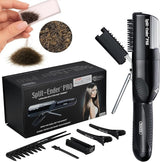
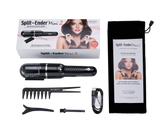
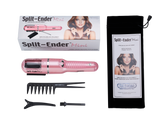
Split Ender tools are designed to trim hair tips, including some split or damaged ends, while aiming to preserve the appearance of overall length.
They do not reverse graying, permanently repair damaged hair fibers, or make hair grow faster.
Always follow the directions and compatibility guidance for each device, especially when working with tightly curled, fragile, tangled, or chemically processed hair.
THE BEAUTY SCIENCE DESK
The Black & Silver FAQ
Why does hair turn gray?
Gray hair commonly develops when pigment production changes during hair formation, influenced strongly by age and genetics.
Does plucking one gray hair cause more to grow?
No. Plucking a gray hair does not cause neighboring follicles to produce additional gray hairs. Repeated plucking may damage follicles.
Is gray hair always coarser?
No. Texture varies among individuals and strands. Pigment loss alone does not determine every hair's feel.
Is black hair naturally healthier?
No. Hair color does not establish overall structural condition.
Why does white hair become yellow?
Environmental exposure, cosmetic deposits, previous processing, and other factors may contribute to visible discoloration.
Does every person with silver hair need purple shampoo?
No. Violet-toned products are optional cosmetic tools for certain unwanted yellow tones.
Can split ends be permanently repaired?
No. Products may temporarily improve appearance, but physically split tips require trimming for removal.
Does trimming accelerate hair growth?
No. Trimming affects existing ends; hair growth originates within follicles.
BEHIND THE BEAUTY
Scientific Background & Further Reading
Explore scientific information about natural hair pigmentation, graying, hair shine, and fiber weathering.
MedlinePlus Genetics — Hair Color
PubMed — Hair Graying and Melanocyte Stem Cells
PubMed — Hair Shine and Light Reflection
PubMed — Hair Weathering and Split Ends
Scientific images are conceptual educational illustrations rather than actual microscopy. The Silver Queen and Midnight Queen are fictional editorial characters.
THE FINAL WORD
Midnight Has Its Magic.
Moonlight Has Its Own.
Pigment can change. Texture can vary. Light can dance differently across every strand. But beautiful hair is not a contest between black and white.
Two Colors. One Biology. Endless Beauty.
EXPLORE SPLIT ENDER →Editorial note: This article provides general educational information about hair science and cosmetic care. Individual hair characteristics vary with genetics, age, texture, processing history, and styling. Gray hair is not necessarily damaged hair, and black hair is not necessarily stronger hair. Consult an appropriate healthcare professional for unusual or sudden hair changes and follow all cosmetic product and device instructions.
SPLIT ENDER · THE HAIR SCIENCE CHRONICLES
The Silver & Shadow Paradox
Black Pearl · Silver Moon · Champagne Gold