

Can Vibrating Hair Tools Really Reduce Breakage? The Science Behind the Buzz
Vibrating brushes and flat irons promise smoother glide, less tugging and gentler styling. The mechanics are intriguing—but does a little buzz actually translate into less breakage?
Apparently our hair tools have started vibrating again.
So can they reduce breakage? They might help reduce one important contributor: unnecessary mechanical force during grooming. Sometimes the force needed to release a snag is enough to stretch, crack or break a vulnerable strand. If tiny rapid movements help a tool move through hair with fewer abrupt snags, some of that stress could drop.
But today's excitement is ahead of the evidence needed to declare vibration a universal breakage-prevention technology. A vibrating flat iron still has heated plates, and vibration cannot reconnect an end that has already split.
Mechanically plausible is not the same thing as clinically proven.
Why Does Hair Break While You Brush It?
At fiber level, brushing is a busy mechanical event: friction between fibers and bristles, bending around them, snagging in knots and tension as you pull through resistance. When strands interlock, the force from your hand is transferred into the hair.
Healthy fibers tolerate plenty of normal grooming. Older, bleached or weathered fibers have less margin for error.
Why hair friction matters more than you think
The cuticle is made of overlapping cells, so hair has natural surface friction. Weathering from age, chemical processing, heat or handling can increase it, making detangling harder. That is why conditioning matters: better lubrication reduces the force needed to separate strands.
What Is Vibration Supposed to Do?
In certain mechanical systems, vibration can reduce sticking at contact points. Applied to a hair tool, the theory is that micro-movement may help bristles or plates keep moving instead of catching abruptly on strands, meaning fewer sudden pulls and lower peak tension.
The key word is “may.” A reasonable mechanical explanation does not tell us how large the real-world benefit is—or whether every vibrating device delivers it.
How might a vibrating brush reduce tugging?
The goal is not to shake damage out of the strand, but to help the bristles move through groups of fibers with less abrupt catching.

But vibration is not working alone. Bristle length, flexibility, spacing and tip shape all influence glide, so when one vibrating brush feels gentler than another, you cannot automatically credit the motor.
Can Less Snagging Really Mean Less Breakage?
This part makes intuitive mechanical sense: if a brush needs less force to move through a tangle, the hair experiences less pulling. That does not guarantee zero damage, but reducing unnecessary force is a sensible hair-care goal.

The tool isn't the whole technique
A motor cannot compensate for aggressive habits. Technique may matter as much as the tool:
Start with manageable sections
Less tangled hair for the tool to control at once.
Begin detangling near the ends
Remove lower tangles before working on knots higher up.
Use adequate lubrication
Conditioner or a detangling product reduces friction before the brush turns on.
Do not fight a snag
Stop, loosen the knot and continue. Vibration is not permission to pull harder.
Are vibrating tools better for curly or coily hair?
Curly and coily hair forms complex tangles, so a tool that minimizes tugging could be attractive, but design and technique still decide the result. For tightly curled hair, detangling damp and well conditioned may be more appropriate than a dry-brushing rule designed for straight hair.
Vibrating Brush vs. Vibrating Flat Iron
A motor in two tools does not make them equivalent. A vibrating brush mainly targets pulling and friction during detangling. A vibrating flat iron adds heat: vibration may influence glide, but hair is still exposed to heated plates.

Why vibration does not make a flat iron damage-proof
A vibrating flat iron is still a flat iron, and excessive heat can weaken the fiber over time. Smoother glide or not, the result depends on how you use it.
| Smarter Thermal Styling | Vibration Cannot Rescue This |
|---|---|
| Use the lowest effective temperature. | Automatically selecting maximum heat. |
| Stop when the desired result is achieved. | Adding extra passes because the tool feels unusually smooth. |
A smoother glide can make a hot tool feel gentler. The hair still knows the plates are hot.
So What Does the Evidence Actually Show?
We know repeated brushing and combing contribute to mechanical wear, and damaged surfaces generate more friction. It is plausible that micro-motion changes how a tool interacts with hair. The missing piece: how much does vibration itself reduce real-world breakage compared with an otherwise equivalent non-vibrating tool? That needs controlled testing of particular designs.
What we can say cautiously
- Snags create localized mechanical force
- Vibration may influence contact and glide
What we should not assume
- Every vibrating tool prevents breakage
- A vibrating iron cannot cause heat damage
Does a vibrating brush stimulate hair growth?
Scalp massage can feel pleasant, but scalp stimulation and prevention of hair-shaft breakage are two separate questions. Growth claims need evidence beyond the fact that a device vibrates.
What should you look for in a vibrating hair tool?
Evaluate the whole device, not the vibration count on the box: bristle design, adjustable settings, precise lower temperatures on hot tools and comfort, since an awkward tool encourages rushed technique. Do not let “12,000 vibrations” end the conversation.
Does Less Breakage Mean You'll Never Get Split Ends?
Unfortunately, hair would like more variables in that equation. Ends also accumulate heat, UV, chemical processing, friction against bedding and normal weathering. A gentler brush reduces one source of stress but cannot freeze the fiber in time, and once an end has separated into branches, vibration cannot permanently reconnect it.
| Vibrating Tool | Split End Maintenance |
|---|---|
| May help reduce tugging during certain grooming steps. | Physically removes an already split or damaged tip. |
| Cannot fuse a separated strand. | Removes the separated portion through trimming. |
A gentler journey through the brush is useful. It does not make the oldest inches of your hair immortal.
Reduce unnecessary stress—and address damaged ends when they appear
Gentler detangling and controlled heat help protect your lengths. When tips have already split, targeted trimming handles the part vibration cannot undo.
Vibrating Hair Tools: FAQs
Do vibrating hair brushes really reduce breakage?
They may help reduce snagging or pulling in some situations if the vibration improves how the brush moves through tangled hair. However, the real-world benefit depends on the complete brush design, hair type and technique, and strong evidence comparing vibration alone is still limited.
Are vibrating flat irons less damaging than regular flat irons?
Not automatically. Vibration may influence glide or strand alignment, but both types expose hair to heated plates. Temperature, number of passes, hair condition and heat protection remain important.
Does a vibrating brush help hair grow?
A vibrating brush may provide a scalp-massage sensation, but that does not by itself prove increased follicular hair growth. Growth claims should be evaluated separately from detangling or breakage claims.
Can vibration eliminate split ends?
No. Vibration may potentially help reduce some mechanical stress during grooming, but it cannot reconnect a hair fiber that has already physically split.
Can Split Ender prevent breakage while brushing?
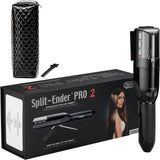
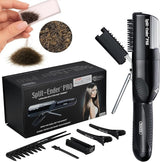
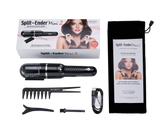
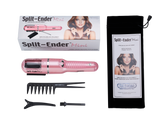
Split Ender is not a detangling brush and is not designed to prevent grooming-related breakage. Its role is split end maintenance: trimming visible damaged tips while helping preserve the appearance of overall length.
This article is for general hair-care education and is not medical advice. Individual hair and scalp needs vary. Stop using any tool that causes pain, scalp irritation, excessive pulling, unusual breakage or other concerning changes, and consult a qualified professional when appropriate.