

WAIT... WHAT ARE THOSE LITTLE WHITE DOTS ON YOUR HAIR?! 😳⚪
Why damaged ends can look speckled, frayed and ready to snap—and when a “white dot” is more than just a split end.
Wait... Why Do My Ends Look Like They Have Tiny White Things Stuck to Them?! 😭
Sunlight hits your ends, you bring one section two millimeters from your eyeball and see tiny pale dots. “WAIT... IS THAT STUCK TO MY HAIR?!” Maybe. Maybe not. What matters is whether you're looking at something deposited on the strand, an ordinary split or broken end, or an actual structural irregularity within the fiber. A white dot alone is not a diagnosis, and trichoscopy or microscopy may be needed when a true hair-shaft disorder is suspected.

Not every visible white point represents the same thing.
Split, dot, snap or fray?
| What You Notice | What It Might Represent | What's Happening |
|---|---|---|
| Y-shaped tip | Split end / trichoptilosis | The distal fiber has divided longitudinally. |
| Pale-looking node on the shaft | Multiple possibilities | Appearance alone is not enough for diagnosis. |
| Material sitting on the strand | Surface residue or other external material | The material may not be part of the hair shaft at all. |
What Is Trichorrhexis Nodosa—and Why Does It Look So Weird?
Trichorrhexis nodosa (TN) is a hair-shaft abnormality characterized by localized weak points or nodes and abnormal fragility. Published clinical reports describe white or whitish nodes, fraying and fracture; under trichoscopy or microscopy, the disrupted fibers can create the characteristic appearance of two paintbrushes pushed together.
Acquired TN can occur after repeated physical or chemical trauma; congenital and condition-associated forms also exist. So a few pale specks at home should not become an instant self-diagnosis.

Conceptual macro view of a weak, frayed point. True hair-shaft disorders require appropriate examination, not diagnosis from a photograph.
When should white dots or breakage be checked by a dermatologist?
Not every strange-looking end needs a medical appointment. But consider professional evaluation if pale nodes appear repeatedly across many hairs with significant fragility or breakage, or if you notice sudden changes, scalp symptoms, localized hair loss, breakage close to the scalp, or difficulty retaining length despite removing obvious damaging practices. Dermatologists can examine the scalp and hair and, when indicated, use trichoscopy or microscopy to distinguish shaft abnormalities that can look deceptively similar without magnification.
THE DAMAGE HISTORYAre White Dots the Same Thing as Split Ends?
No. Trichoptilosis is the familiar split end: the distal shaft divides longitudinally into two or more branches. A pale node associated with shaft fragility can occur differently, a broken hair may simply terminate abruptly, and something external can also be sitting on the hair. For a deeper look at how an ordinary split begins, see the science of split ends and what happens inside the hair shaft.
Not WHITE = SPLIT END or WHITE = LICE. Ask: What is the actual fiber doing?
Why are the ends usually the ones looking “rotten”?
The ends are the oldest exposed portion of long hair, with more time to experience washing, brushing, friction, sunlight, heat styling and chemical processing. Hair-weathering literature describes damage as typically becoming more prominent toward the distal portion of long scalp hair. Your roots are new here. Your ends have RECEIPTS. 🧾

Splits, breakage, frizz and uneven terminal lengths can coexist in the same lower section.
As fibers split or break at different points, the bottom perimeter loses uniformity, which is why ends can look fuzzy and see-through while the upper length still appears dense.
Does Bleach Make Those White Dots More Likely?
Bleaching, coloring, perming and straightening can contribute to exaggerated hair weathering because chemical processing can alter the cuticle and increase susceptibility to subsequent mechanical damage. That does not mean every white dot is caused by bleach. For the bigger picture, compare the major categories in heat, chemical, mechanical and split end damage.
Can heat cause weak points too? And what the hell is bubble hair? 🔥
Bubble hair is an acquired thermal hair-shaft abnormality in which cavities or air-filled spaces develop within the fiber after excessive heat exposure. Published case literature has documented bubble hair after hot ironing wet hair, and it can leave hair dry, brittle and prone to breakage. No, this does not mean your little white dot is a bubble. Our heat damage vs. split ends guide helps separate two problems that often get lumped together.
WHAT PRODUCTS CAN — AND CAN'T — DOCan Conditioner Fix a White Fracture Point?
Conditioners and leave-ins can reduce friction during grooming. But improving how a damaged fiber behaves is different from erasing its structural history. “Repair” is a broad cosmetic term, and if the distal fiber is already physically split, coating it is not equivalent to a brand-new untouched tip. See whether split ends can actually be repaired without cutting them.
The crime scene still happened. 😭
The “please stop beating up the ends” plan
More temperature is not automatically more styling performance.
Inappropriate high heat on wet or damp hair has been associated with bubble-hair injury.
Pulling harder is not an advanced technique. 😭
Once physical splitting and terminal damage are present, a sensible trimming strategy becomes part of the conversation.
Okay... So What Do You Do With the “Rotten” Ends?
If the issue includes ordinary split and damaged ends, trimming can be one part of a broader routine. You don't automatically need a huge haircut; that depends on the condition of the ends, the desired shape and how much length you want to preserve.
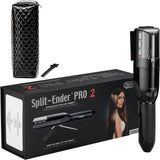
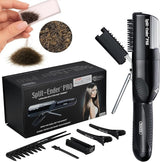
This is where Split Ender has a specific role: split- and damaged-end trimming while preserving the appearance of overall length. Split Ender is not a treatment for trichorrhexis nodosa, bubble hair, lice, scalp disease or another medical hair disorder. It does not diagnose white nodes and it does not reverse chemical damage.
Explore PRO2
Explore Mini 2
Explore Mini
If you're using a Split Ender, technique matters too. See how to use Split Ender correctly on dry hair.
FAQWhite Dots on Hair: Frequently Asked Questions
What are the little white dots on my hair?
They can have several explanations. A pale-looking point may be external material on the strand, a broken or frayed area, or—in some cases—a feature associated with a hair-shaft abnormality. Appearance alone cannot determine the cause.
Are white dots on hair always split ends?
No. A classic split end, or trichoptilosis, involves longitudinal splitting that begins at the distal tip. White-looking nodes or specks can have other explanations.
What is trichorrhexis nodosa?
Trichorrhexis nodosa is a hair-shaft abnormality characterized by fragility and nodes where fibers can fray and break. Microscopy can show the characteristic “paintbrush” fracture pattern.
Can Split Ender treat white nodes?
Split Ender is designed for trimming split and damaged ends. It does not diagnose or treat trichorrhexis nodosa, bubble hair, lice or medical hair-shaft disorders.
When should I see a dermatologist for white dots or hair breakage?
Consider professional evaluation when white nodes or breakage are widespread, persistent, sudden, unexplained or associated with scalp symptoms, localized hair loss or severe difficulty retaining length.
Science Sources
So... Are Your Ends “Rotten”?
SOMETIMES... IT IS THE HAIR. 😳🔬