


Why Does Blonde Hair Turn Green in Swimming Pools? The Copper Mystery Nobody Expected
Chlorine gets the blame. But another element may be the real culprit.
You blamed the chlorine. Your blonde hair turned green. But what if the real culprit was hiding in the water all along?
Picture this: you spend a beautiful afternoon swimming. The water sparkles. The sunshine is glorious. Then you catch your reflection. Are those ends… green?
Not golden. Not platinum. Not even a fashionable shade of mint. Green.
The first suspect is chlorine. But the chemistry of green swimming-pool hair has a surprising twist: researchers have repeatedly found copper associated with that unexpected color.
Does chlorine really turn blonde hair green?
The classic green discoloration seen in some swimmers is primarily associated with copper deposits on or within the hair fiber—not simply chlorine acting as a green dye.
Copper may enter pool water through copper-containing algaecides or corrosion. Light hair makes a green cast easier to see; chemically treated hair may be more susceptible to metal accumulation. Chlorinated water can contribute indirectly under some conditions, but chlorine alone is not the whole explanation.
The medical term for green hair discoloration is chlorotrichosis. Let’s open the case file.
Why Does Everyone Blame Chlorine?
Chlorine has a reputation. It is widely used to disinfect swimming-pool water, and swimmers often associate it with dryness, roughness, and changes in how their hair feels. So when blonde hair develops a green tint, chlorine becomes the obvious suspect. But being present at the scene does not necessarily make it responsible for the color.
In a 1980 investigation, researchers analyzed hair from 11 cases of green discoloration. Using electron microscopy and X-ray microanalysis, they detected substantial copper concentrations in every affected sample. Copper was more concentrated toward the outer regions of the hair fibers. Experiments suggested that damage to the cuticle under certain water conditions could increase copper uptake.
This creates an important distinction: copper may be directly associated with the green appearance, while chlorinated water may contribute indirectly to changes in the hair fiber under some conditions. Neither factor explains every possible case of unusual hair color.
How Does Copper Get Into Swimming-Pool Water?

Copper is not always an accidental visitor. Some pool-maintenance products contain copper compounds because copper can help control algae. Copper may also enter water when certain metal components corrode. Once dissolved copper is present, it can interact with hair.
In a published case report titled Pseudo Green Hair, a previously highlighted blonde swimmer developed green hair after swimming in a pool with elevated copper levels. The investigators reported that chlorine and pH measurements were within the evaluated ranges, while copper was elevated. Another blonde swimmer had experienced a similar problem at the same pool.
A separate 1988 clinical and chemical investigation documented a pool copper concentration of 9.94 parts per million, alongside markedly elevated copper in affected hair. Researchers connected the pool’s metal concentration to copper-containing algaecides and inadequate water replacement. These individual investigations are not proof that every pool contains problematic copper.
A swimming pool can look beautifully clear and still contain dissolved metals. Water clarity cannot reliably establish copper concentration; appropriate testing is required.
Why Is Green Hair More Noticeable on Blondes?

This question has two parts: color contrast and fiber chemistry. On very light blonde, platinum, gray, or white hair, an unexpected green cast can be easier to see. Darker natural pigments may make subtle discoloration less obvious. That does not mean copper interacts only with blonde hair.
Many people with light blonde hair have undergone highlighting, bleaching, or other oxidative color treatments. Those processes can alter the fiber’s chemical structure. Research published in the Journal of Cosmetic Science examined how colored hair incorporates copper and calcium from water. Oxidation during hair coloring can create chemical groups that provide additional binding sites for metal ions.
Naturally blonde hair and heavily bleached hair are not chemically identical. If green discoloration concentrates in highlighted sections, their treatment history may be relevant—but appearance alone does not prove the cause.
Why Can Chemically Treated Hair Hold Onto More Metal?
A hair strand is a layered biological fiber. Its outer protective layer, the cuticle, is important—but the story goes deeper than whether the cuticle is simply “open” or “closed.”
Hair contains keratin proteins stabilized partly by disulfide bonds. During certain oxidative color treatments, sulfur-containing structures can be converted into new chemical groups, including cysteic acid. Such changes can provide additional sites that interact with positively charged metal ions.
Scientists have used high-resolution techniques, including NanoSIMS, to study metal distribution in treated hair. Research on colored hair documented spatial patterns of calcium uptake and discussed mechanisms relevant to copper binding. The detailed calcium maps should not be described as identical proof of copper distribution.
Two swimmers can therefore have different visible results after exposure to the same water. Hair color, prior chemical processing, and fiber condition can all matter.
Can You Remove the Green Tint Without Making Things Worse?

The temptation is immediate: find something in the kitchen, mix a few ingredients, and scrub until the green disappears. But hair that has already undergone bleaching or chemical treatments may be vulnerable to aggressive experimentation.
Certain chelating agents can bind metal ions and help with their removal. EDTA is one example used in some cleansing and cosmetic formulations. In a 2024 dermatological case report, clinicians used an EDTA-containing shampoo for a young swimmer with green discoloration, reporting substantial improvement over an eight-week follow-up. That is a case report, not a guaranteed treatment timeline.
First, consider whether the discoloration appeared after swimming, particularly in a pool with a possible metal issue. Avoid concentrated acids, bleach, peroxide mixtures, or harsh improvised treatments. A product formulated for metal buildup may be useful when used as directed; for heavily processed or fragile hair, seek professional advice.
If elevated copper is suspected, the pool’s water should be tested and corrected by qualified maintenance personnel. Handle wet or chemically treated hair gently, especially if it already feels fragile.
Does Green Hair Mean Your Hair Is Damaged?
Not necessarily. A visible color change and structural damage are different phenomena. They may coexist, but one does not automatically prove the other.
Copper accumulation can change hair appearance without every affected fiber being broken. The fiber’s condition still matters: oxidative treatments and environmental exposure can affect the cuticle and other structures. Research on metal uptake in colored hair has also raised concerns about copper’s potential involvement during subsequent oxidative color treatments.
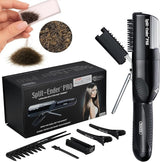
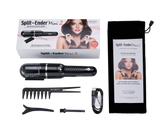
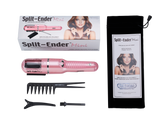
The Split Ender PRO2 is designed to help trim protruding damaged ends as part of a hair-length maintenance routine. It is not a treatment for copper deposits or green discoloration. Follow the manufacturer’s instructions, including use on fully dry, detangled hair.
| What you notice | What it may indicate | What to focus on |
|---|---|---|
| Greenish tint after swimming | Possible copper-associated color change | Water source and appropriate metal-removal care |
| Rough, difficult-to-manage hair | Surface changes, friction, or other factors | Gentle conditioning and handling |
| Frayed or divided ends | Split ends | Appropriate end maintenance |
| Snapping strands | Hair-fiber breakage | Reducing stress and assessing damage |
The Pool-Side Checklist
- Wet your hair with clean water before swimming as a practical way to reduce initial pool-water exposure; this does not guarantee protection against copper deposition.
- Consider a swim cap to reduce direct contact, recognizing that swim caps are not always watertight.
- Rinse your hair thoroughly after swimming.
- Use conditioning care suited to your hair texture and treatment history.
- If green discoloration keeps returning, investigate the pool’s copper level instead of repeatedly treating only the hair.
These are reasonable exposure-management practices, not a clinically validated guarantee against green hair.
Questions Swimmers Actually Ask
Can chlorine alone turn blonde hair green?
Classic swimmer-associated green hair is more strongly linked to copper deposits than to chlorine acting as a dye. Chlorinated water may contribute indirectly under some conditions.
Can natural blonde hair turn green in a pool?
Yes. Green discoloration has been documented in light-colored hair, although susceptibility varies. Chemically treated hair may have additional risk factors.
Why do only the ends of my hair look green?
The ends may have experienced more cumulative weathering or chemical treatment, and the color may be more visible there. Location alone cannot establish the cause.
Does clarifying shampoo remove copper?
Not every clarifying shampoo is formulated to bind or remove metals. Products designed for metal buildup may contain chelating ingredients; results depend on the formulation and circumstances.
Will the green color disappear by itself?
The appearance may change with washing and reduced exposure, but there is no reliable universal timeline. Persistent discoloration may need targeted care or professional assessment.
Does green hair mean my pool is unsafe?
It can be a clue that copper levels warrant investigation, but it cannot establish whether the pool meets health and maintenance standards. Water testing is needed.
Can Split Ender PRO2 remove green hair?
No. Split Ender PRO2 trims protruding damaged ends; it does not remove copper deposits or correct hair color.
Scientific Sources & Further Reading
-
Copper in green hair: a quantitative investigation by electron probe X-ray microanalysis
Clinical investigation of copper in 11 cases of green hair. -
Copper and calcium uptake in colored hair
Research on how oxidative hair coloring influences metal uptake. -
Pseudo Green Hair
Clinical report of green hair associated with elevated pool-water copper. -
The Greening of Hair: A Unique Case of Chlorotrichosis and Its Management
Clinical report discussing treatment with an EDTA-containing shampoo. -
Green hair: clinical, chemical and epidemiologic study
Clinical and chemical investigation of pool-associated green hair.
Editorial note: Much of the clinical literature consists of case reports and small observational investigations. These findings support the role of copper in documented cases but do not establish that every green hair discoloration has the same cause.