

Why Does Hair Feel Different Wet vs. Dry? The Science of Hair Texture
The surprising science behind softness, friction, and what your hair is really telling you.
You step out of the shower, run your fingers through your freshly conditioned hair, and everything feels wonderfully soft.
Smooth. Silky. Effortless.
Then your hair dries.
Suddenly, the ends feel rougher. Your fingers don't glide quite as easily. That luxurious softness you felt in the shower seems to have disappeared.
It's tempting to blame your conditioner, reach for another hair mask, or assume your hair is damaged.
But here's the fascinating part: Your hair doesn't necessarily have to be damaged to feel different when it dries. Sometimes, the explanation is written in the physics of the hair fiber itself.
Why Does Hair Feel Different When It's Wet and Dry?
Hair can feel different when wet versus dry because water, surface friction, conditioning ingredients, and the physical properties of hair fibers all influence how strands behave and feel to the touch.
When hair is wet, water changes its physical properties, while conditioning products may temporarily improve how smoothly individual strands slide against one another. As hair dries, those conditions change. Depending on your hair's natural characteristics, surface condition, and products, you may notice more resistance, tangling, or roughness.
A change in texture is an observation—not a diagnosis of damage.

What Actually Changes When Hair Gets Wet?
Hair is a complex biological fiber made primarily of proteins, with surface lipids and structural layers that affect how it responds to water and handling. When water enters the fiber, it changes its dimensions and mechanical behavior. But wet hair is not automatically healthier, smoother, or stronger.
Water content, surrounding humidity, surface condition, and products can all influence how hair behaves. Even the feeling of wetness is more complicated than it seems: experimental research suggests that changes in surface temperature contribute to how people perceive wet hair during drying.
Notice whether your hair feels slippery while conditioner is present, whether it resists gentle finger-combing as it dries, and whether the difference is concentrated near the ends. Avoid tugging on wet strands just to test them.
Wet hair feels different because its physical environment has changed—not because water has magically repaired the fiber.
Why Smoothness Is About More Than Moisture

There is a field of science devoted to friction, lubrication, and wear: tribology. It offers a useful way to understand the sensation of smoothness. Individual hair strands slide against one another, fingers, combs, towels, and clothing; resistance during those contacts can influence how the hair feels.
The outer cuticle and its lipid-rich surface help determine frictional behavior. A component associated with the natural hair surface is 18-methyleicosanoic acid (18-MEA). Chemical processing and accumulated wear can alter surface characteristics, but friction also depends on humidity, conditioning ingredients, and the direction of contact.
Ask whether the hair itself feels rough to the touch or whether several strands are simply difficult to separate. These experiences can overlap without being identical.
Sometimes, what we call dryness is partly a story about friction.
Why Hair Can Feel Silky in the Shower

Conditioner can make hair feel transformed: strands glide, tangles loosen, and the surface feels more pleasant. Many formulations use conditioning agents, fatty alcohols, polymers, or silicones to influence the way fibers interact.
Depending on the formulation, ingredients can deposit on or associate with the hair surface, improving lubrication and reducing combing forces. Some benefits persist after rinsing, but the feeling of wet, product-coated hair need not match the feel of fully dry hair. Cosmetic improvement is not the same as completely reversing structural damage.
Compare three moments: while conditioner is on the hair, after it is rinsed out, and when the hair is fully dry. Each reveals something different about the routine, but none is a laboratory diagnosis.
Conditioner can improve the way hair behaves and feels without permanently rebuilding every part of the fiber.
Why Everyone's Hair Tells a Different Story
Straight, wavy, curly, and coily hair do not all arrange themselves in the same way. Fiber shape, diameter, prior treatments, and everyday wear can influence tangling, friction, and the sensation of texture.
Environmental conditions and surface treatments can also affect how fibers interact. Two people can follow similar washing routines and still experience very different results after drying. That does not prove one person has healthier hair.
Consider your own baseline: has your hair always felt this way, or has its behavior changed noticeably after processing, frequent heat styling, or another stressor? A new change is worth noticing, but touch alone cannot establish the cause.
Your hair’s natural texture isn’t a problem that needs to be corrected.
What Your Hair Can—and Can't—Tell You
Online shortcuts promise a diagnosis from a strand floating in water, a quick rub between the fingers, or how long hair takes to dry. Hair science is more complex than any single home observation.
Researchers use controlled methods to study friction, mechanical properties, moisture interactions, and structural changes. A strand floating in a glass of water is not a validated standalone test of porosity. Likewise, roughness cannot quantify cuticle damage or identify one perfect product.
Notice repeatable patterns across ordinary wash days: which products seem to improve manageability, where tangling occurs, and whether a change persists. Use those observations to guide gentle care, not to assign a diagnosis.
Your hair can give you useful clues. It cannot deliver its own laboratory report.
The Wet-to-Dry Texture Diary
No special tools, no floating strands, no aggressive rubbing. Just curiosity during your usual wash routine.
Notice how your hair feels after your usual conditioning routine. Is it slippery, easy to separate, or resistant to gentle movement?
Without repeatedly handling or pulling your hair, observe whether its movement or texture appears to change.
Notice the final texture. Does it feel different at the roots, mid-lengths, and ends?
Across normal wash days, look for a consistent pattern or a meaningful change.
This is not a porosity test, a damage assessment, or a substitute for professional advice.
Notice the change. Don't rush to diagnose it.
Wet vs. Dry Hair: What the Differences Might Mean
| What You Notice | A Possible Explanation | What to Remember |
|---|---|---|
| Hair feels slippery with conditioner | Surface lubrication from water and conditioning ingredients | Slipperiness does not prove structural repair |
| Hair feels different after drying | Changes in moisture, surface interactions, and friction | A texture change is not automatically damage |
| Ends feel rougher than roots | Differences in wear, treatments, and surface condition may contribute | Location is a clue, not a diagnosis |
| Hair tangles more when dry | Fiber interactions and friction may be involved | Gentle handling matters |
| Hair feels textured but looks healthy | Natural fiber characteristics may influence touch | Texture alone does not determine health |
| Hair changes noticeably after processing | Chemical or mechanical changes may affect the fiber | Persistent changes deserve closer attention |
So, Does Rough Hair Always Need More Moisture?
Not necessarily. “Dry hair” can describe several different experiences: a rough surface, tangling, stiffness, dullness, or a lack of softness. Those sensations can overlap without sharing a single cause.
A conditioning product may improve manageability by reducing friction. A gentler routine may limit additional mechanical wear. And when ends have accumulated physical damage, conditioning may improve their feel without eliminating split or fractured sections.
What About Split Ends?
A split end is a physical change to the hair fiber. Conditioners and styling products may temporarily improve how damaged ends feel or appear, but they do not permanently fuse a split fiber back into its original structure. Removing damaged ends through trimming is a separate form of maintenance.
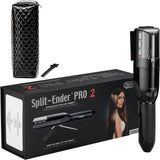
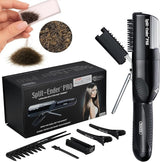
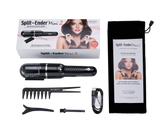
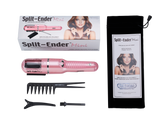
For those exploring split-end maintenance between traditional haircuts, the Split Ender PRO2 is designed to trim hair ends when used according to its instructions. It is not a treatment for hair loss, a way to stimulate growth, or a method of reversing structural damage throughout the hair shaft.
The goal is understanding the difference between making hair feel better and removing an already damaged end.
Frequently Asked Questions
Why does my hair feel soft when wet but rough when dry?
Water, conditioning ingredients, and friction can influence how hair feels. As hair dries, its physical conditions and surface interactions change. A rougher sensation does not automatically mean damage.
Does rough hair mean I have high-porosity hair?
No. Roughness alone cannot establish porosity. Products, natural texture, and surface condition also affect the sensation. A quick touch test is not a reliable standalone porosity measurement.
Why does my hair feel amazing with conditioner but not afterward?
Conditioners can improve lubrication and reduce friction, particularly while the product is present. The final sensation depends on what remains after rinsing and on how the hair behaves when dry.
Can healthy hair feel rough?
Yes. Natural texture and fiber interactions can affect touch. Roughness by itself does not prove a strand is unhealthy.
Does air-drying prevent hair damage?
Not automatically. Avoiding high heat reduces one possible stressor, but friction, tangling, and rough handling can still occur during drying.
Can conditioner permanently repair damaged hair?
Conditioners can improve appearance, manageability, and surface behavior. Those benefits should not be confused with completely reversing all structural changes in a damaged fiber.
The Receipts
These references explore the physical behavior of hair fibers, friction, conditioning, and sensory perception.
-
Understanding and Controlling the Friction of Human Hair (2025)
Hair friction, wear, and conditioning. -
Friction and Surface Temperature of Wet Hair (2016)
Tactile perception during drying. -
Electrokinetic Analysis of Conditioner Ingredients
Conditioning ingredients and hair interactions. -
On Hair Care Physicochemistry (2023)
Hair structure, surface behavior, and conditioning. -
A Curly Q: Is Frizz a Matter of Friction? (2021)
Humidity, fiber characteristics, and frizz.