

"Love Layers" Are Trending for Fall 2026—But Can Layers Really Make Hair Look Fuller?
A haircut can change geometry far more easily than biology—so what is actually becoming "fuller"?
What Are "Love Layers"?
Love Layers are Fall 2026's soft, personalized take on movement: long blended layers, strategic face framing and fluid bends. Instead of one heavy perimeter, selected sections are cut at different lengths so the hair can move, separate and expand visually without a dramatic loss of overall length.

For the bigger Fall 2026 picture, explore our Fall 2026 hair trends guide.
What Does It Actually Mean When Hair "Looks Fuller"?
Hair conversations often use density, thickness, volume and fullness as though they were interchangeable. They are not.
Density
How much hair is present within an area of scalp: the population of fibers, not the haircut shape.
Diameter
The physical caliber of an individual fiber. Fine and coarse describe fibers, not how many hairs are present.
Volume
The three-dimensional space the hairstyle occupies, shaped by texture, styling and layer placement.
Fullness
The overall visual impression of abundance—what your eyes interpret before anyone counts fibers.
Can Layers Increase Hair Density or Make Fine Strands Thicker?
No. Cutting the visible shaft does not create additional follicles, and a layer does not permanently increase the diameter of the individual fiber. Fine hair and low-density hair are not automatically the same thing.
How Can Layers Change Fullness Without Adding Hair?
Imagine a long haircut with nearly every strand ending at the same lower perimeter, so much of its visible weight sits near that bottom edge. Shorten selected sections and the visual architecture changes even though the supply of hair has not. Shorter sections can lift away from longer ones, face-framing pieces create expansion around the cheekbones or shoulders, and internal layers reduce a heavy block of hair so texture moves more freely.

A haircut can change how facial proportions appear in the same way; see our guide to haircuts and face shape.
What Can Love Layers Change—and What Can They Not Change?
| Feature | Can Layers Change It? | Possible Visual Effect | Reality Check |
|---|---|---|---|
| Perimeter weight | Yes | Can make ends look heavier or lighter depending on design | Too much removal may reduce visual fullness |
| Hair density | No | No new follicles are created by cutting | Density is not a haircut effect |
| Fiber diameter | No | A cut may make the overall shape look stronger | It does not permanently thicken individual strands |
Can Too Many Layers Make Fine or Lower-Density Hair Look Thinner at the Ends?
They can. Layering works partly by removing or shortening selected lengths. If too much weight is removed from a perimeter that already has limited visual density, the lower section can look transparent, wispy or insubstantial.

That does not mean fine hair cannot have layers or that low-density hair must always be cut blunt. It means the amount, depth and placement of layering need to respect the starting material.
Does Hair Texture Change What Love Layers Will Actually Do?
Absolutely. Natural wave or curl can create visible expansion between fibers, while straighter hair reveals the perimeter and layer transitions more clearly. A photo of layered straight hair is not a universal cutting diagram for wavy, curly or coily hair.
How Should You Choose Love Layers for Your Own Hair?
Is the Blowout Doing Part of the Work?
Often, yes. Round-brush tension, root direction, curl pattern and drying technique can all exaggerate the architecture the haircut created, so judge an inspiration photo once for the cut and once for the finish. If your favorite version needs frequent hot-tool styling, heat exposure becomes part of the maintenance equation.
Where Does Split End Maintenance Fit Once You Love Your Layers?
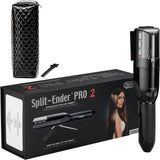
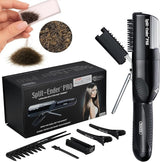
Your haircut creates the architecture: perimeter, face framing, layer placement and silhouette. Split Ender has a narrower role: trimming split and damaged ends along the hair while helping preserve the appearance of the surrounding length.
It does not add density, thicken fibers, create Love Layers or replace a haircut. It makes sense when you already like your long layers and want to target split or damaged ends without a major haircut.
Products may temporarily smooth a split end, but only trimming removes it. Explore the science of split ends, and before using a device, follow the correct Split Ender preparation and use guide.
Rechargeable split and damaged-end trimming.
View Split Ender PRO2A compact rechargeable option.
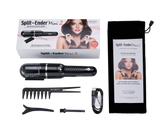
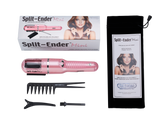
View Split Ender Mini 2A compact option for targeted maintenance.
View Split Ender MiniFrequently Asked Questions
1. Can layers really make hair look thicker?
Layers can make hair look fuller or more voluminous by changing silhouette, movement and weight distribution. They do not permanently increase individual fiber diameter or create additional hair follicles. On some fine or lower-density hair, too much layering can even make the ends look lighter.
2. Are layers good for fine hair?
They can be. Fine hair can benefit from strategic movement and shape, especially when density is sufficient to support the design. However, excessive layering can sometimes remove too much visual weight from the lower perimeter, so placement matters.
3. Can too many layers make hair look thinner?
Yes. Because layers shorten selected sections, aggressive layering can leave fewer fibers reaching the longest perimeter. On some lower-density or delicate-looking hair, that can make the ends appear lighter or more transparent, which does not by itself mean the layers damaged the hair.
4. Can Split Ender create or maintain my layers?
Split Ender is not a layering or haircut-design tool. Its role is trimming split and damaged ends. A stylist or conventional haircut determines the actual layer architecture, perimeter and silhouette; Split Ender helps maintain the ends within the shape you keep.